Masterclass: Using Commerce Content for Sustainable Acquisition
Written by Richard Towey on 10 minute read
Wondering why everyone’s talking commerce content? Read on for a Masterclass on how to turn it into one of your strongest acquisition channels.

Menswear brand State & Liberty makes precisely what a lot of shoppers are searching for: athletic-fit suits, shirts, and pants.
The problem wasn't demand; it was visibility. Strong competition in the SERPs, patchy presence in the listicles that mattered, and in some cases, product links that led nowhere at all.
We sat down with Joe Sanfilippo, Vice President of Growth & Partnerships at Today's Business (State & Liberty's affiliate agency), and Ryan Murphy, Partnerships Manager, Commerce at New York Post, to find out how a single proactive ask turned into a multi-year content partnership now driving new customers both online and in-store.
You can listen to the full podcast episode to hear how the partnership came together, or read the write-up below.
Finding the gap: from 404s to blank space
Today's Business has managed State & Liberty's partnerships program for over five years. Before the New York Post partnership existed, an audit of the brand's presence in relevant editorial told its own story.
Joe: "I did an audit before I went in, so I showed them all of the opportunity: ‘Hey, you're not in any of these articles that you should be in. The entire company's built around athletic-fit dress shirts. How are you not in these?’ And then in some instances they were in them, but the publishers were sending the traffic to broken links and 404s. So I'm like, ‘you guys are literally missing out on revenue just by not being active in the channel’."
That channel was commerce content, defined as:
“Editorial material, like product reviews, buyer's guides, and comparison lists, created by publishers that helps people make buying choices.”
On the publisher side, the opportunity was already partly built. New York Post had spent around six years assembling a deep library of SEO-optimized evergreen listicles for its commerce section. It had the authority to get a brand like State & Liberty indexed and moving.
Ryan: "Those first few years were really about building out our content, ‘Best shirts for men’, ‘Best this’, and ‘Best that’, to have a really good catalog of evergreen content. So when Joe came to us with State & Liberty, the content existed, it was due for an upgrade, and getting product in our hands, having people actually see and review it, that's a huge benefit for us too."
Setting a realistic bar for upper-funnel content
State & Liberty's brief to Today's Business wasn't an aggressive ROAS target. It was to get as close as possible to a 1:1 return on ad spend, with new customer acquisition front and center.
Joe: "Can we at least try to get to a one-to-one return on investment? We're willing to spend on new customers, but if we could break even and acquire new customers, great. Anything above that is fantastic."
Joe frames that target by comparison, not in isolation.
Joe: "I look at Google ad campaigns from brands all the time, and it's always like, my branded search is 10:1, 40:1. But all of their non-branded searches are usually 1:1 or below. So if you can get above 1:1 on a content partner, which are for prospecting campaigns, in my opinion, that is very strong, especially if you're acquiring a lot of new customers with good lifetime value."
That reframing matters. It's the difference between judging content performance against your best channel and judging it against the channel it's actually replacing.
Making editorial and commercial work together
Speaking from New York Post's perspective, Ryan is candid that the usual divide between editorial and commercial teams doesn't hold up in his role.
Ryan: "As much as we want to talk about separation of church and state, we wouldn't be able to do what we're doing if that was the case. We need to know what the editorial team is pitching, what's trending, what's working, what's not working. I'm not only reaching out to people; I have people reaching out to me too. I can say, ‘Hey Joe, someone on the editorial team pitched this. I think it'd be a great fit for State & Liberty’. And on the flip side, Joe comes to me and says, ‘Your content's ranking, we'd love to work together.’"
Joe sees the payoff of that structure clearly from the publisher’s perspective.
Joe: "It's so hard to find a team that truly works cohesively. There are a lot of people who keep it so separated, and it doesn't make sense to me, because although editorial should always be edit-first, if something's selling, it means it's resonating. You should look to your commerce team and go, ‘Oh, this works, our audience likes this’."
Crawl, walk, run: proving the model before scaling it
Rather than launching across dozens of articles, the partnership deliberately started small.
Ryan: "Probably a cliché at this point, but one of the things you really have to do in partnerships is crawl, walk, run. Let's not do everything all at once… It's a partnership, it's not a deal."
Joe: "We started with one placement. We said, ‘Hey, this is the lowest-hanging fruit based on what you're trying to achieve, let's start here’. The results were exceptional, and then we just rolled from there."
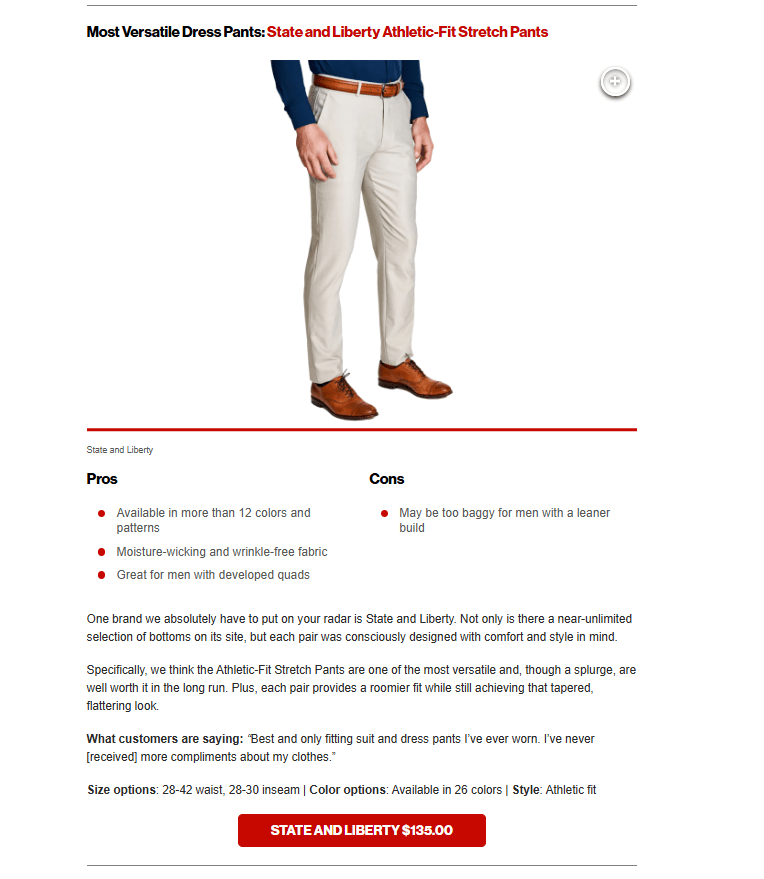
The first placement, a review of State & Liberty's Athletic-Fit Stretch Pants inside a roundup of top dress pants for men, sitting alongside established names like lululemon, Dickies, and BOSS, hit its 1:1 ROI target within two months, with 65% of resulting customers new to the brand, well ahead of the 50% goal.
That early win built the case for more budget and more placements. Within the first four months, as we reported in our overview of the partnership, the wider rollout was hitting 89% new customers against target. By the end of year one:
- 78% new customers (+44% above target)
- 5,600+ clicks generated
- 226% increase in revenue, comparing the full year to the initial four-month period
Taking commerce content offline
One of the more distinctive extensions of the partnership was geo-targeted, in-store-focused content.
Joe: "State & Liberty has store locations in New York… This is New York Post. What better fit to help drive in-store traffic? We started running that type of content and have been happy with those results too. It's a little bit harder to track, but for sure worth it."
Joe: "We really just look at how much traffic is on that page in general, and then we look at the keywords, because it's kind of just an awareness play. If it's ranking for 'where to buy suits in New York,' I assume it's people either in the city or traveling to the city looking to shop. No matter what, that intent is very strong."
Ryan's data backs up why the local content works well beyond New York itself.
Ryan: "We have this crazy statistic where the New York Post reaches one in every other New Yorker, which is insane to begin with. But that's like a fraction of our entire audience. 92% of it is outside of the tri-state area. So even though we're getting people in the New York area to go to the store, it's still great for anyone who's searching for suits, whether they're in Chicago, Texas, or California."
What's next: diversifying into new audiences
The next phase of the partnership is about audience, not just article count. New York Post's stable includes NYPost.com, Decider.com, and Page Six.
Ryan: "Page Six is gossip, tabloid, celebrity-focused — a bit of a higher AOV, but a much different demographic. We've been leaning way more into commerce content on Page Six lately, and it's performing really well. Some of it's performing better than certain New York Post things. That could be a really interesting thing to look into with State & Liberty, because it's a completely different, more female-driven audience."
For a menswear brand, that's not an obvious move. Until Joe explains the pattern he sees across the category.
Joe: "Page Six is a huge opportunity, because with a lot of the brands we work with in men's fashion and sports, you think it's going to be all men. It's almost half women. A lot of the pro athletes who wear State & Liberty have wives and girlfriends who are featured on Page Six all the time. There's a huge opportunity to weave those things together."
The closing advice
Asked what they'd tell any brand just getting started in affiliate, both were direct.
Ryan: "You have to do your research. It's not something you just go into willy-nilly. What we've done with State & Liberty might not work copy-pasted for someone else. You have to find what works for your brand, who your audience is, what's going to resonate. And you have to be open to trying new things."
Joe: "The minimum commitment is one year, absolute minimum. It takes time to build trust, time to get product to editors, and get them excited… There's really no reason not to have an affiliate channel. You can set it up however you want to make sure it always works for your business. It's a hundred percent customizable. It should be an ongoing evergreen channel.
Launching commerce content on Awin
For advertisers looking to turn editorial into a genuine acquisition channel, partner with New York Post or explore Awin's wider network of editorial and content publishers to find the right fit for your brand.
FAQ: Turning commerce content into a sustainable acquisition channel
What is commerce content in affiliate marketing?
Commerce content refers to editorial articles, such as product roundups, reviews, and "best of" listicles, that include affiliate links, allowing publishers to earn commission on resulting sales while readers get independent-feeling product recommendations.
Why is commerce content useful for customer acquisition?
Because it targets non-branded, high-intent searches, commerce content reaches shoppers earlier in their research process than bottom-funnel channels, making it an effective way to reach and convert new-to-file customers rather than just remarketing to existing ones.
What ROI should brands expect from top-of-funnel content placements?
A 1:1 return on ad spend is a reasonable benchmark for non-branded, prospecting-style content. It should be compared against other prospecting channels, where returns are often at or below 1:1, rather than against paid search, which performs a different role.
How should a brand start a content partnership with a publisher?
Start with an audit to identify where the brand should already be ranking but isn't, and where existing links may be broken.
From there, agree on a single, low-risk placement to prove results before requesting a larger budget or wider rollout.
Why is collaboration between editorial and commercial teams important?
When editorial and commercial functions work in isolation, publishers can miss opportunities to align high-performing content with a relevant brand, or offer brands options only after content is already published. Closer collaboration lets both sides pitch each other proactively.
Can affiliate content drive in-store as well as online sales?
Yes, though it's harder to track directly. Geo-targeted local content (for example, "where to buy X in [city]") can be measured using proxy signals like page traffic and keyword rankings, and can support both in-store footfall and broader brand awareness among readers outside that immediate area.