Insight of the Month: The Commission Group Multiplier Effect
Written by Emelia Orezzi on 5 minute read
Do affiliate programs with a diversified commission group structure drive more revenue? Awin Customer Experience Team Lead Emelia Orezzi digs into the data.

Armchair vs. adventure: when it comes to affiliate marketing, which group are you in?
Well, statistically, it’s bad news. Our analysis of nearly 4,500 live programs on the Awin platform shows that 63% still run on a single commission group.
That’s ‘armchair’ for you. One commission group, e.g. 5% offered for sales, all across the board.
Now let’s look at the opportunity of expanding that, even by just one or two groups.
The numbers
To get a reliable sample, we focused solely on programs that had made sales in the 31 days leading up to May 20, 2026.
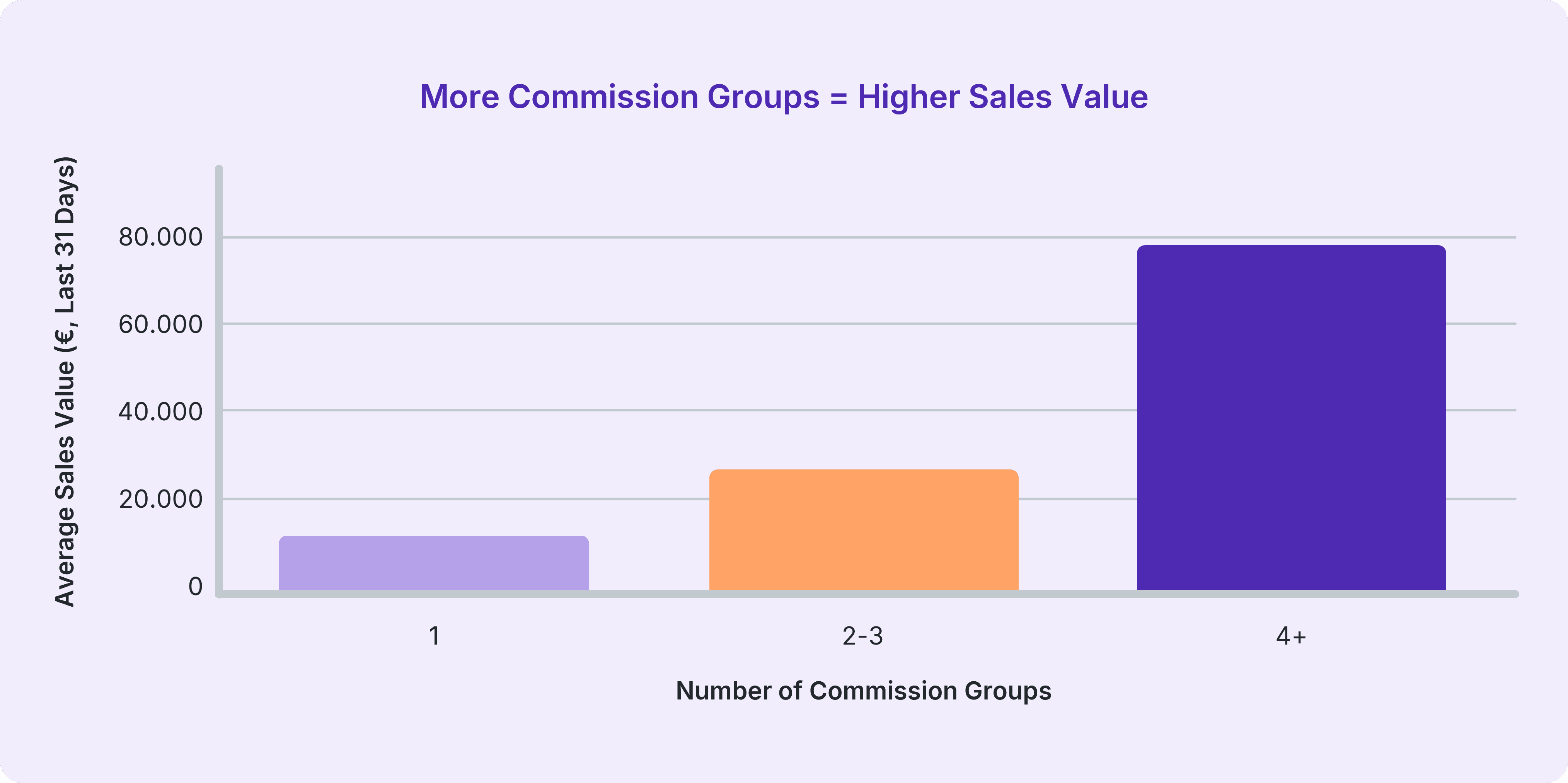
From that analysis, we can see that affiliate programs running 2–3 commission groups generate more than double the revenue of those on a single flat rate, increasing by +126%.
Push that to 4+ groups, and the uplift is +546%. That’s not incremental, it’s transformational.
We've seen this play out before
While the data is striking, the success of advertisers that experiment, test, and generally sample more of what the affiliate channel has to offer goes back a number of years.
In 2022, we ran a comparable study looking at how a diversified partner mix, rather than commission structure specifically, affected performance.
Advertisers were once again split into two groups:
- Armchair advertisers who stuck to a narrow set of core partner types, e.g. coupon, cashback.
- Adventure advertisers who actively diversified through non-traditional partner types, like comparison shopping services (CSS), tech partners, and influencers.
The results told a similar story across every metric:
- Adventure advertisers saw traffic grow 29% year on year against a 6% decline for armchair advertisers, largely due to declines suffered by core partner types.
- Sales for adventure advertisers grew 33% versus 16% for armchair.
- Average order value also held up better for the diversified group (+9%) vs the stagnant cohort (+2%).
Examples of affiliate commission groups to try out
A well-built commission group structure isn't just a pricing exercise. Over time, it has a compounding effect, becoming a lever for shaping publisher behavior.
If you’re unsure where to start, here are some great examples of commission groups to launch:
- By publisher type: See more value in certain partner types over others? Tailor your commission rates to reflect that strategy and take more control over who promotes your brand.
- New vs. returning customers: Offer a higher commission for any sale where the customer is new to your brand, incentivizing publishers to prioritize acquisition over repeat purchases.
- By product category or margin: Drive real growth by offering better rates for higher-margin lines (or overstocked/seasonal stock you want to shift) to make each sale more profitable.
- Performance tiers: Apply commission rate increases in steps once a publisher crosses a monthly sales threshold. E.g. 5% commission up to $10,000, 7% from $10,000 - $30,000, and 10% beyond that, encouraging partners to hit the next level.
By launching each of these ideas, you tap into the following advantages:
- Better publisher promotion: Publishers actively compare programs and prioritize the ones that reward higher-value actions.
- More new customers: By rewarding new-customer sales at a different rate to repeat purchases.
- Alignment between commission and product margin: Higher-margin lines can carry higher rates and pull in more targeted promotion.
- New top contributors: By giving partners a reason to push past their current volume to hit the next rate.
Case study: SharkNinja
A great example of an advertiser experimenting with multiple commission groups is electronics giant SharkNinja.
Its use of Awin’s Commission Flexibility tool means it can set individual rates to promote products according to its sales priorities. Not only that, it has a valuable partner in closed user group Blue Light Card to immediately get new promotions live.
The opportunity gap
Despite the patterns, most advertisers haven't made the shift to rewarding on different outcomes.
As we mentioned earlier, 63% of Awin programs still run on a single commission group. Only 5% have adopted the 4+ structure that our data shows performs best.
That presents a huge opportunity for advertisers to get out of their armchairs and start experimenting.
What to do next
If you're running 1 commission group, start by creating 2–3. Even a simple split (e.g. new vs existing customers, performance tiers) could make a big difference.
If you're already running 2–3, expand to 4+ to unlock the 6.5x multiplier effect. Think about product-category-specific groups to align your program with selling priorities.
If you're running 4+ groups already, don't stop there. Layer in a more diversified mix of partner types, exploring fast-growing concerns like brand partnerships, influencers, and tech partners.
And review everything quarterly, not annually. Commission group structures should evolve as your program matures and your publisher mix diversifies. Treat this as a living part of your strategy, not a one-off setup task.
All the evidence points the same way. The programs that build in flexibility, in who they partner with, and in how they reward them, are the ones that pull ahead.