Insight of the Month: CPI – What Happened Next?
Written by Alfie Staples on 7 minute read
What happened to the 2,000 advertisers that upgraded their tracking following Awin’s CPI? It’s Insight of the Month time.

Thousands of upgrades. Millions of dollars in commission and revenue, recaptured and rightfully attributed. Relationships strengthened. Heaps of new intelligence on what really works. One year later, we have the privilege of assessing the impact of Awin’s Conversion Protection Initiative.
Announced at PI Live way back in 2024, our decision to enforce higher tracking standards for advertisers running affiliate programs on Awin’s platform aimed to draw “a line in the sand”. The value of our channel had been clouded by threats ranging from growing ad-blocker usage to third-party cookie deprecation. By our own estimates, 12.6% of regular sales were going untracked, while those directed to apps were out by 20%.
Outdated tracking standards were not fit for the current landscape, and something had to be done to reclaim all the sales and partner commissions that were being missed as a result.
CPI goes live
Advertisers had until April 7, 2026 to upgrade their tracking. By March 2026, we were delighted to report that over 2,300 Awin advertisers had made that move.
Over 1,600 gained an improved server-to-server standard and over 760 implemented tracking for their app.
Those upgrades led to CPI reclaiming $578 million in revenue and recovering $37 million in partner commissions that would otherwise have been missed.
Networks like Rakuten Advertising launched similar initiatives. CPI won Gold for Excellence in Transparency & Compliance at the 2025 GPMAs. Our press-clipping tower grew taller by the day.
Rather than resisting change, stakeholders at some of our biggest advertisers commended CPI for inspiring their long-overdue actions.
Amy Hockin, Head of Paid Traffic Acquisition at Virgin Media, described CPI as “the fuel” that prioritized an upgrade that was already delivering “a clearer understanding of the value each channel drives, aiding smarter investment decisions."
Meanwhile, partners like TopCashback claimed to have already used CPI payments to invest in improving their customer experience.
It’s important to reflect on all these moments and celebrate their impact on the affiliate channel on the whole. But our mandating of tracking improvements was equally about empowering advertisers to measure more, learn more, and use that extra insight to put their budgets in the right places.
Now we can see what impact that had.
Measuring impact
We decided the best way to measure the impact of improved tracking was to assess the performance of advertisers with either or both of the two CPI-approved standards (server-to-server and app tracking) in the year following the launch of CPI.
For clarity, all Awin advertisers that have not implemented these standards now adhere to our probabilistic model, where they pay extra commission to account for the volume of events likely to be missed by their setups.
From the 2,300 advertisers that had upgraded, we took out some low-volume programs that would skew the findings (<20 sales per day) to produce a consistent set of median readings.
Server-to-server impact
For those advertisers implementing server-to-server tracking, traffic was down 0.9% in the year to March 2026 but incredibly stable against our platform average, which was down -15% year on year.
AOV is similar, too, albeit slightly up on the year before. Then came the real gains.
Advertisers who upgraded their tracking reported a +3.5% increase in sales. But the biggest takeaway came from the proportion of visitors who converted into customers.
At a time where price sensitivity is forcing conversion rates to stagnate, advertisers that upgraded their tracking reported a 6.4% increase in conversion rates year on year.
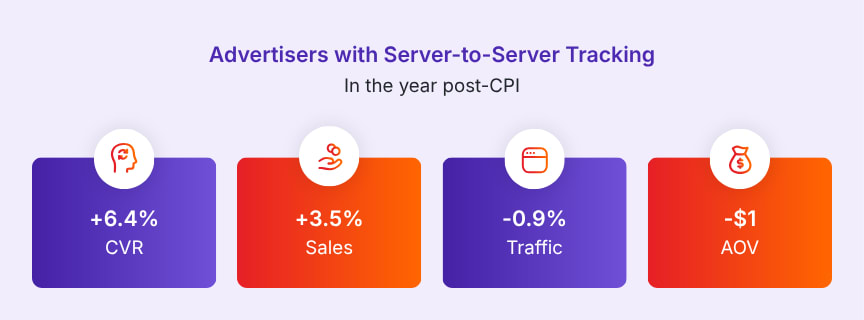
There’s a very simple way of putting this.
Advertisers with better tracking are capturing more conversions from the same level of demand.
And why wouldn’t they? By upgrading your tracking, you measure the true value of your partners. You can then allocate budget to the ones that are most effective at getting sales over the line.
App impact
Among advertisers with a transactional app, for whom app tracking became mandatory, our figures showed some variance but with improvements in similar areas.
App traffic declined -17% year on year to align with our platform average (-15%). App downloads on the whole declined last year, signaling a potential drop in demand for in-app commerce on the whole.
AOV remained stable, just as it did for our server-to-server adopters. And there it was. Conversion rates on the rise, this time by a staggering 9.6% year on year.
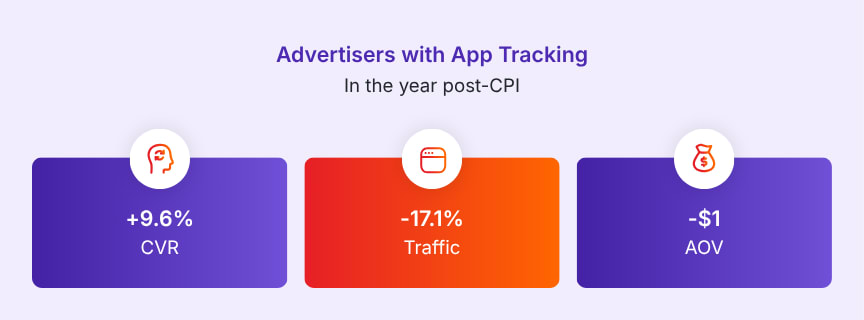
One more time for those at the back, then.
Advertisers with higher standards of tracking, whether they’re directing customers to websites or apps, are converting customers at a higher rate.
A near 10% increase in conversion rates is the type of impact you’d be pleased to report after years of UX improvements. That same increase is being delivered by a simple upgrading of infrastructure and a few months of optimizations.
And it goes even higher in some cases. Recently, Amy Denton from Wowcher dropped by the Awin-Win Marketing Podcast studio to discuss her use of app tracking solution Button.
Together with Joanna Cornish from Button, the pair confirmed the extent to which in-app conversions had improved after optimizing based on a clearer view of affiliate-assisted journeys.
App tracking brought a 31% increase in conversion rates for Wowcher. Prior to Button, 29% of orders came from the retailer’s app. That’s now at 50%. These improvements cannot be understated by any advertiser trying to grow an app.
Top 20 impact
For the rubber-stamp treatment, we looked at the top 20 highest-performing programs on our platform. We were certain these advertisers would act on the data gleaned from a clearer view of their partner contributions, usually with the help of Awin’s experts.
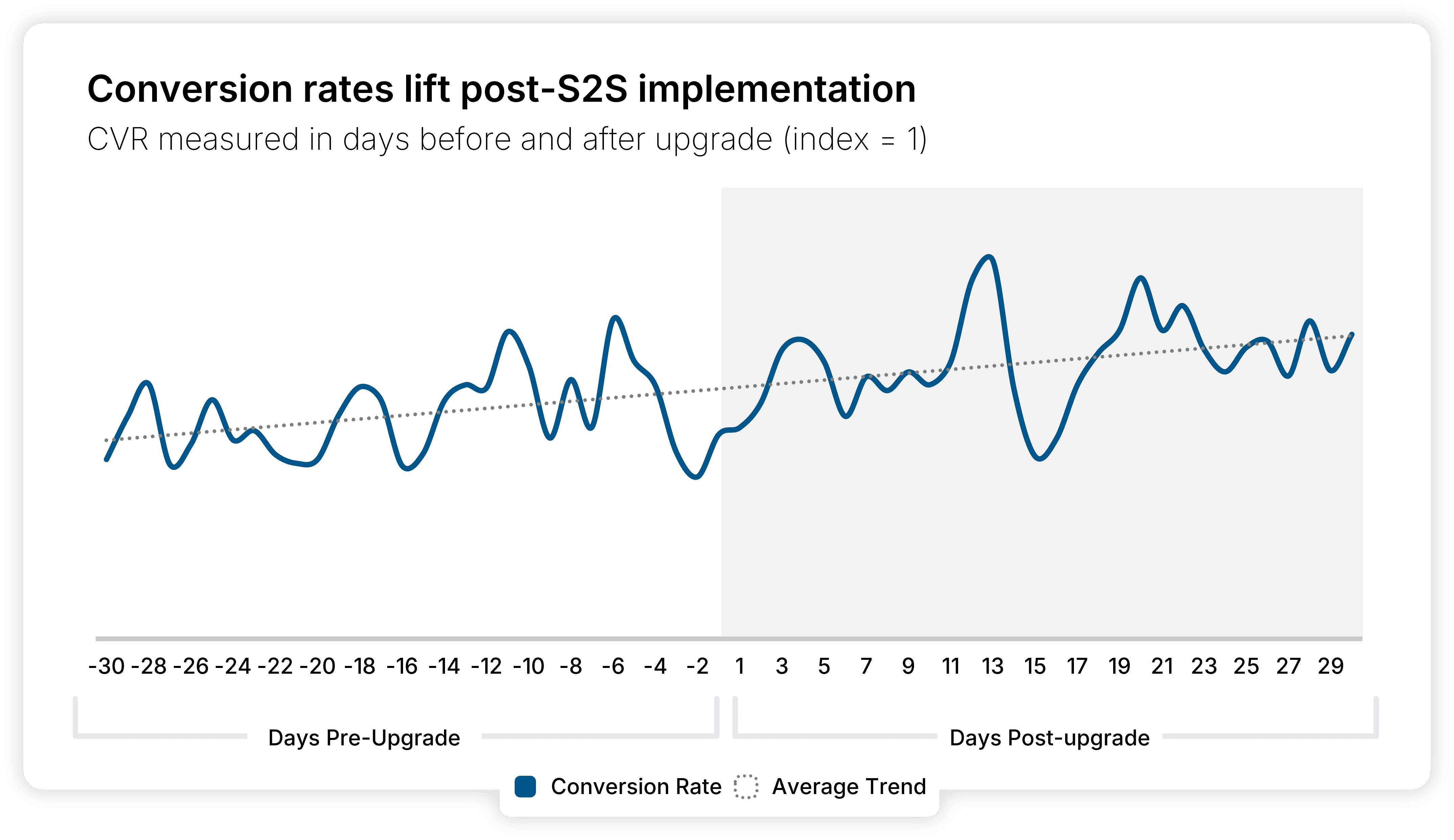
In this test, we looked at the immediate impact. Counting exactly 30 days from their implementation of improved tracking, what did they see?
While absolute readings like clicks (-16.8%) and commission paid (-16.5%) fluctuated at levels you’d expect from all the sales, product launches, and partner activations that either did or didn’t occur, it was the aggregated metric that stood out.
Conversion rate uplift 30 days after tracking upgrade: 14.4%. The trendline shows just how soon advertisers managed to trigger a major uplift.
Potentially… just the start
If you feel like you’ve heard this all before, you have.
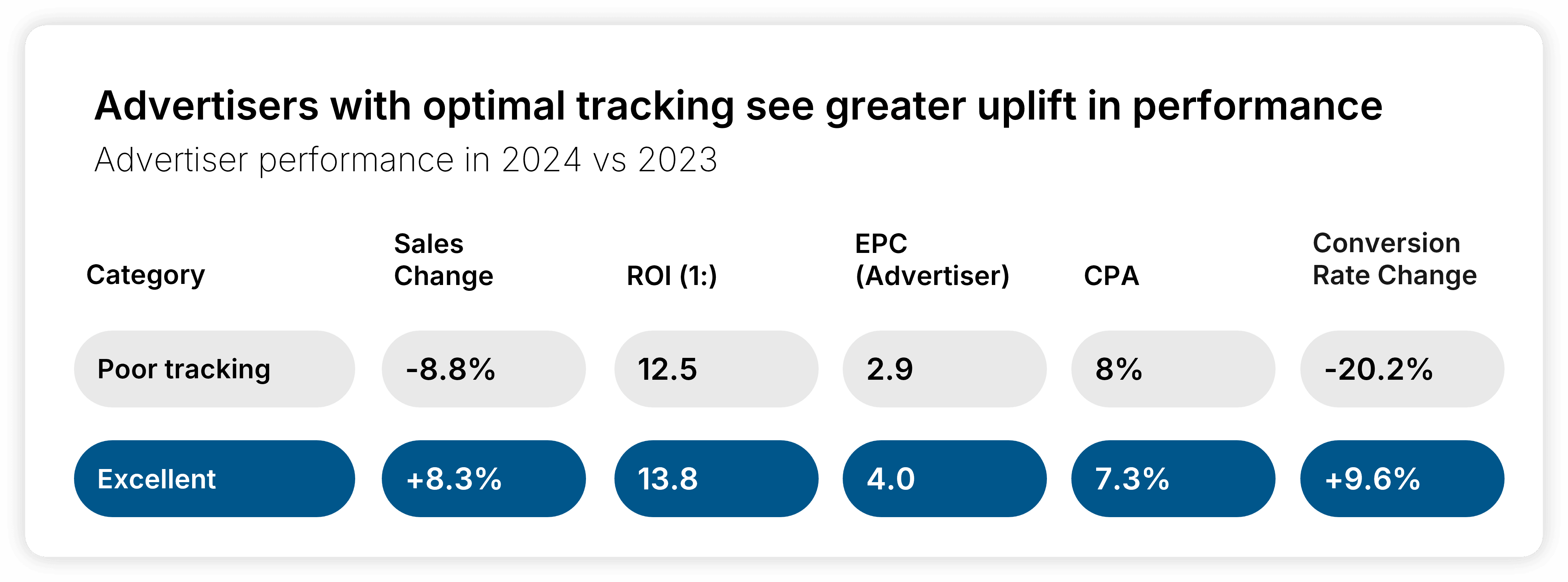
Awin’s Insight of the Month is no stranger to a dig into the relationship between tracking and performance. In 2025, following the announcement of CPI, we once again compared a cohort of Awin advertisers with poor tracking (no S2S or mobile app tracking implemented) against one with an optimal setup (S2S and mobile app tracking implemented).
The difference was that advertisers with high-quality tracking could have made those changes years ago, rather than in the past 12 months, creating more time for learnings and optimizations.
The conclusions were even firmer, with sales up 8.3%, conversion rates increasing 9.6%, and higher readings for ROI (13.8 vs 12.5), earnings per click (4.0 vs 2.9), and a lower CPA (7.3% vs 8.0%).
 We’re not there yet
We're elated with the early impact of CPI on advertiser performance, partner commissions, and the affiliate channel as a whole. But we're not done yet.
Thousands of programs still operate on our probabilistic standard, and the case for upgrading to server-to-server or app tracking has never been clearer.
In a landscape where traffic is flat or falling, conversion rate is the metric that matters most. Everywhere we look, better tracking moves it.
If you’d like more information on Awin’s CPI, visit our hub. Or if you’re ready to take the next step, our new tracking guide has everything you need.