Insight of the Month: Two Years On, Has the Affiliate Landscape Changed?
Written by Alfie Staples on 12 minute read
It's been two years since we launched Awin's Power 100. We looked at the data behind four growing areas of partner representation to find out what's changed.
The Power 100, our index of the most innovative partners on the Awin platform, is back.
On our last time out in 2024, it was already clear the affiliate channel was outgrowing its old reputation as a pure coupon and cashback play.
Influencers, tech partners, and even brands hosting offers from fellow brands made the cut. So, with a refreshed 2026 index now live, we wanted to ask the obvious question.
Has the landscape moved even further?
To answer that, we pulled the data behind four areas of growing representation within the list:
- Influencer marketing
- Brand partnerships
- Closed-user groups
- AI shopping
Influencer marketing leads the charge
Content creators were always going to be the headline act of this year's Power 100. Compared to our last index, representation has shot up +180%.
Influencer/blogger is now the second-most common partner type on the Power 100, behind the combined cohort of coupon and cashback.
Part of that growth comes down to Awin making it easier than ever for creators to get started.
Our dedicated influencer app removes the friction that previously held mobile-first creators back. We provided a separate, more streamlined route for people who run their entire business from a phone.
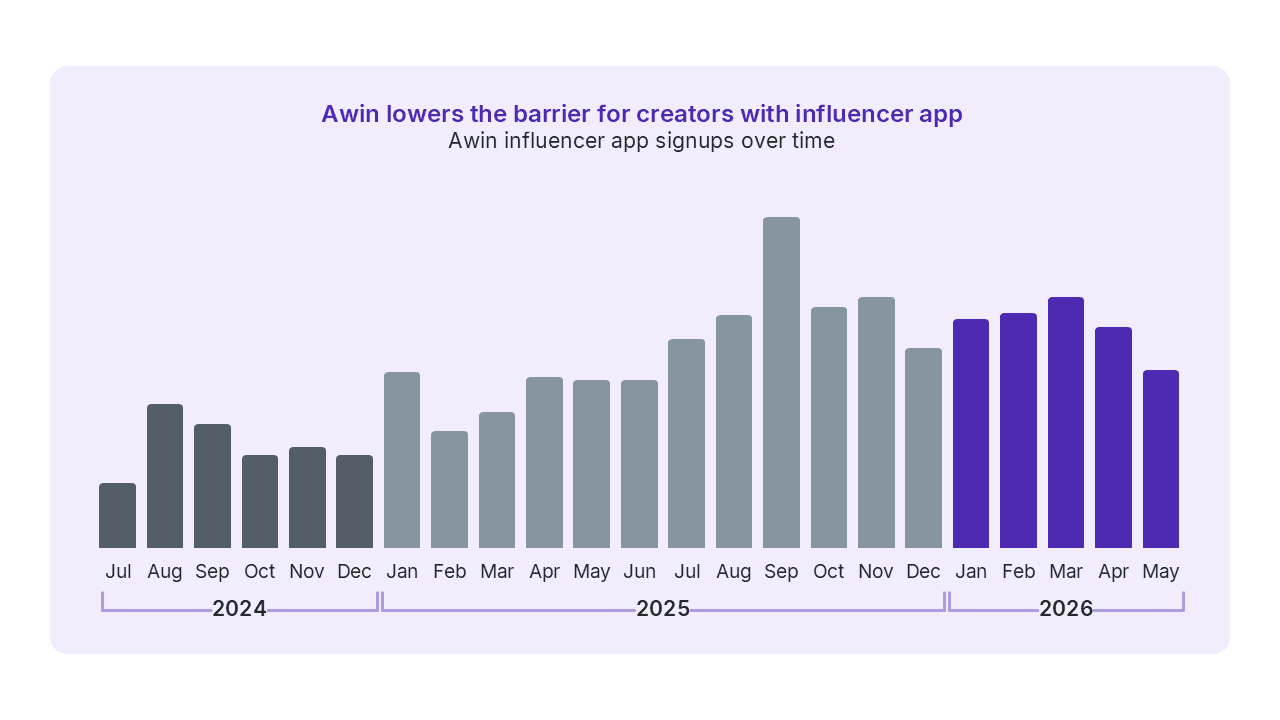
You can see the impact in our own sign-up data.
Looking at data from 2024, monthly registrations through the app were at 1,400 in July. They soared to a peak of over 7,400 in September 2025, with sign-ups in 2026 consistently running at double the levels in 2024.
Where creators actually post
Lowering the barrier to entry is one thing. Understanding where those creators show up is another.
Instagram remains the dominant platform for content creators on Awin, but its grip is loosening.
In 2024, Instagram accounted for 78% of creators' primary platform. That’s now down to 62% in 2026. TikTok is the clear winner of the difference, growing from 6% to 15% of primary platform share over the same period.
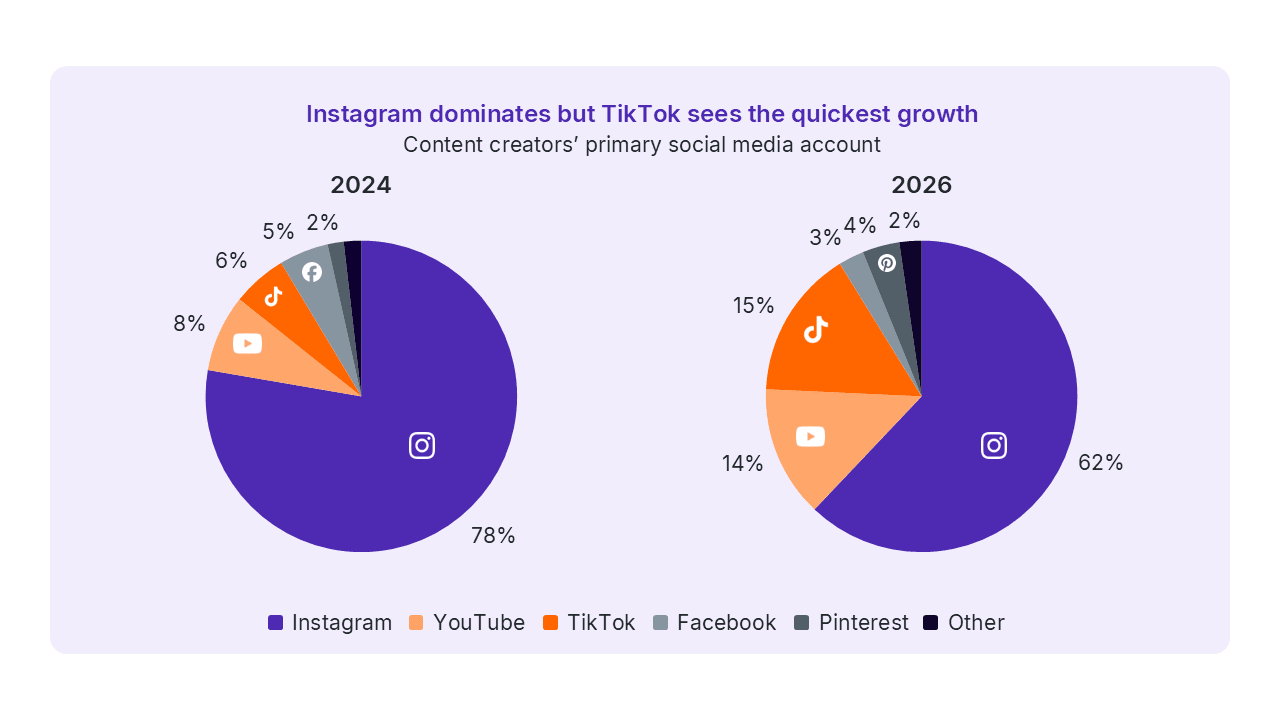
YouTube has also seen its share rise from 8% to 14%, while Facebook and Pinterest have both ceded ground.
Case study: Fnac focuses on the bigger picture
French retailer Fnac is a good example of what influencer marketing can deliver on your affiliate program.
Rather than treating influencers as a campaign tactic, Fnac partnered with tech partner Shop My Influence via Awin to launch a fully-branded mobile app, Fnac Ambassadeur, giving creators self-serve tools to build affiliate links, manage wishlists, and track earnings in one place.
The results speak for themselves:
- Fnac centralized over 550 influencer partnerships on a single, branded platform
- The program hit a 7:1 return on investment in year one.
- The following year, sales through the program grew +853% year on year
View the full case study to learn more.
Listen up: Boots migrates influencer efforts to affiliate
Another success story can be found on Awin-Win Marketing Podcast, where Boots' Ellie Waters and Metapic's Sarah Boudissa discussed how one of the UK's biggest health and beauty retailers folded influencer activity into an affiliate program that had historically leaned on cashback and discount sites.
Power 100 influencers to watch:
- Alini Bosko (Brazil): One of the most-followed individual creators in this year's index, Alini is part of a wave of Brazilian influencers whose hundreds of thousands of fans have helped push LATAM representation in the Power 100 to new highs.
- TecnoArt (Brazil): With over two million YouTube subscribers, TecnoArt is one of Brazil's leading voices in PC hardware, gaming, and technology, offering a route into a niche community actively researching purchases.
- HMBLE (Italy): A newer name in the index, HMBLE (an Italian eSports specialist) is reflective of the smaller, niche-focused creators now finding a home in affiliate alongside the established giants.
View more influencers on the Power 100.
Brand partnerships: one deal, three winners
Influencer marketing isn't the only category pulling its weight. Brand partnerships, which see one advertiser hosting rewards from another, have scaled quickly too.
Total revenue generated through these activities on Awin’s platform grew from $229 million in 2024 to $272 million in 2025, up 18%. Meanwhile, the number of active brand-partner programs climbed from 207 to 225, up 9%, over the same period.
What makes this category distinctive is that a single deal can benefit three different partners at once:
- The host earns commission by sharing rewards on its own site or app
- The advertiser acquires new customers by placing its offers in front of that audience
- And, increasingly, a tech partner sits in the middle, powering the whole experience.
That last point matters more than it might first appear.
Looking at our top 10 brand-partner hosts by sales generated, eight are powered by an affiliate tech provider or specialist loyalty/rewards platform, rather than running the technology in-house.
A few great examples from our new Power 100 are:
- eBay (Global, powered by Thanks): eBay uses post-purchase rewards specialist Thanks to turn its "thank you" moments into a monetizable touchpoint, surfacing curated, relevant offers from non-competing brands right when customers are most receptive.
- Sky VIP and Sky Sports Rewards (UK, powered by Tyviso): Sky VIP rewards customers simply for being with Sky, creating one of the UK's most loyal entertainment audiences.
- Currys (UK, powered by BrandSwap): UK electronics and technology retailer Currys has a post-purchase rewards channel powered by BrandSwap, delivering a selection of offers to consumers who have recently completed a transaction.
Case study: EE creates retention-boosting program
If you’re interested in earning commission by hosting rewards, rather than acquiring customers by delivering them, you’re in good company.
EE, part of BT Group and one of the UK's largest wireless carriers, had no rewards program at all until it partnered with Tyviso to launch EE Rewards.
EE reduced churn by 34.5% by launching a rewards program powered by affiliate brand partnerships. Additionally, 90% of customers who visited EE Rewards returned at least once within six months, highlighting its popularity.
View the full case study to learn more.
Listen up: SimplyCook pays $1 million in commission to THG brands
We’ve heard plenty of these stories on Awin-Win Marketing Podcast too, including THG Ingenuity (The Hut Group's commerce arm) and recipe kit provider SimplyCook, discussing the success of their full-funnel partnership.
View more brand partnership hosts on the Power 100.
Closed-user groups close the gap on coupon sites
Built to reward disabled shoppers, NHS staff, students, employees, and more, closed-user groups (CUGs) have become one of the fastest-growing partner types on our platform, and the Power 100.
We’re not oblivious to their similarities with regular coupon sites. Many CUGs prove their worth by delivering incentives to their audiences. Those audiences are just a little narrower than your average coupon site’s.
But it raises a fair question: are brands that once invested heavily in coupons now simply migrating the budget to CUGs?
It's genuinely hard to say whether budgets are moving from one side to the other. What we can say is that the trajectory has changed sharply since our last Power 100 in 2024.
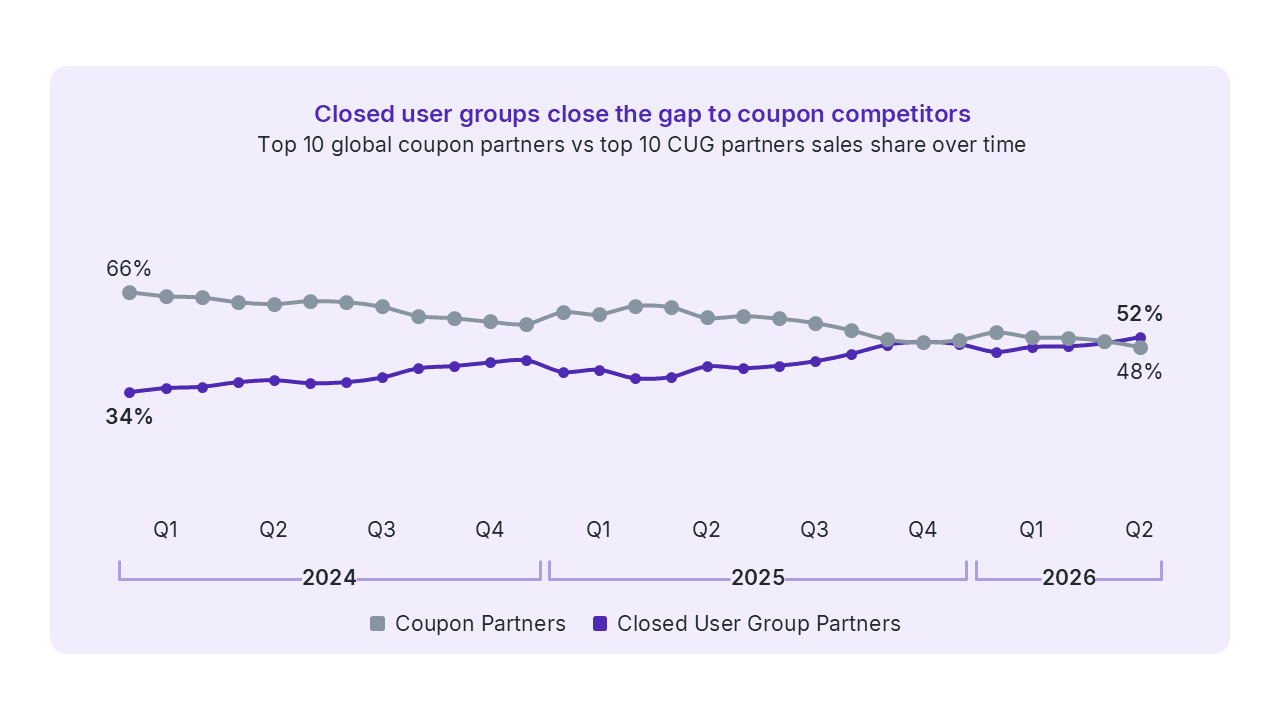
Looking at the top 10 global coupon partners against the top 10 CUG partners by share of sales, in oddly convenient circumstances, coupon's share has fallen 18 percentage points, while CUG’s has risen by the same amount.
Coupon partners dropping from 66% to 48% amid a surge in CUG from 34% to 52% meant CUG overtook coupon sites for the very first time.
Maybe advertisers are getting better at zoning in on specific audiences. Or maybe coupon strategies are still thriving, albeit under a new name.
A few great CUG examples on our new Power 100 are:
- Purpl (UK): The UK's first money-saving membership built specifically for disabled people and those with long-term health conditions, giving brands access to a closed community with an estimated $470 billion in annual spending power.
- Inspiring Benefits (global): An employee savings club model used by major employers across Spain, Portugal, Italy, Greece, the UK, and Mexico, with members saving more than $9 million through the platform to date.
- ihrhelden (Germany): A closed discount community for verified key workers and other eligible professions, using AI-backed verification to deliver exclusive deals beyond what's publicly available.
AI shopping: the newest affiliate partner type
And now for something completely different.
Two years ago, "AI shopping" wasn't a category in the Power 100 at all. Now it has its own dedicated label, covering partners using natural language understanding and intelligent product matching to reshape how consumers discover and buy.
To give you a taste, here are some AI shopping partners on the Power 100:
- Channel3 (US): By organizing the information that AI agents use to recommend products, Channel3 helps brands get discovered on AI shopping platforms without any technical lift on their side.
- ShopSense AI (Canada, US): Connects retailers with premium publisher and broadcaster content, making it simple for consumers to shop products they see on TV.
- Daydream (US): A personal stylist and conversational shopping platform using natural language understanding to deliver tailored product recommendations.
How AI impacts affiliate journeys
Since 2024, AI’s impact on our channel has been incredibly broad. From powering the intelligence of our tech partners, to the influence on how shoppers use it to inform their decisions, it’s ubiquitous.
Looking at the influence on shopping journeys, we are starting to get a clearer idea of how to reshape your strategy for the AI era.
The big headline: volume is still very small. Only 0.2-0.5% of affiliate sales on Awin currently contain AI traffic across the UK, US, Germany, and France. That’s defined as a journey that includes a click-through from an LLM-powered tool, like ChatGPT, that ends in a sale.
But, where AI and affiliate intersect in the same journey, the behavioral shift is significant.
Cart values rise by up to 119% depending on the market. Even the lowest reading (27% in Germany) marks a huge increase.
However, so does the time to conversion.
AI shopping journeys on average take 60% longer to complete. That peaks at 89% longer in the UK from a baseline of 31% in the US.
That extra level of consideration is validated in the number of steps taken before purchase. AI shopping journeys involve 81% more steps in Germany, going up to 128% in the UK.
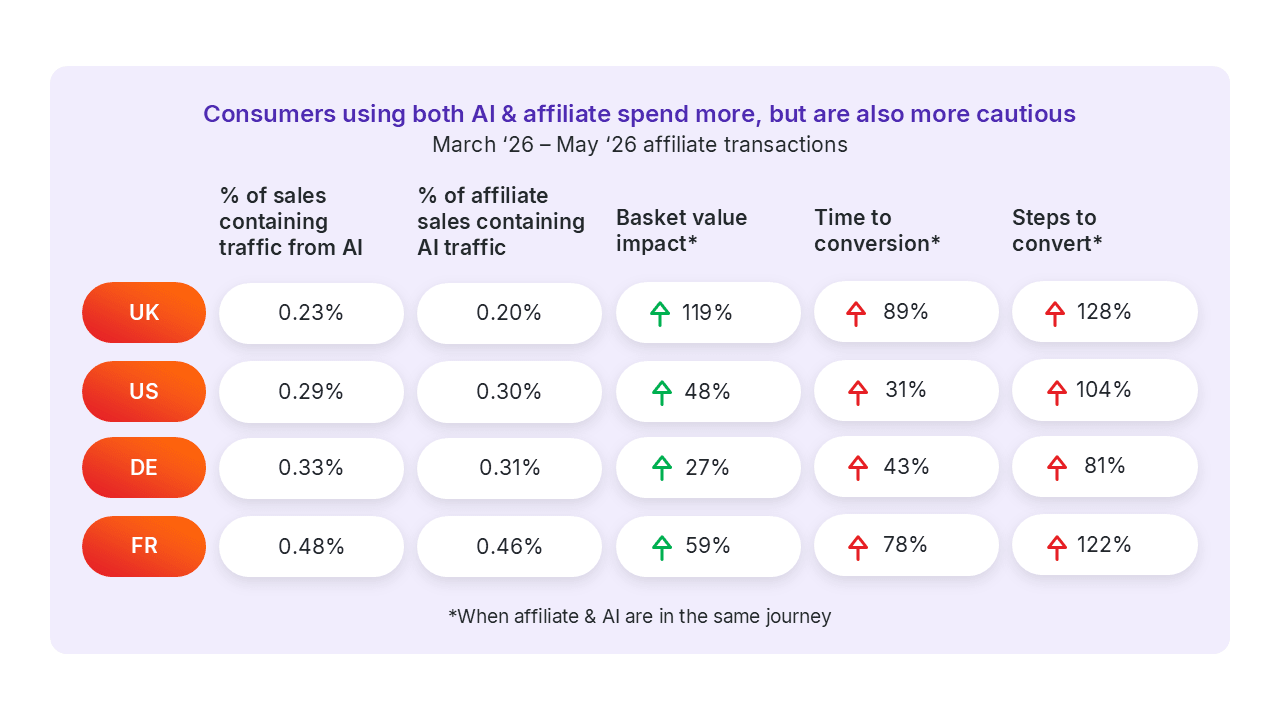
In other words, shoppers using AI alongside affiliates are spending more, but taking longer and doing more research before they commit.
Though it purports to make our lives simpler, AI is adding consideration, not removing it.
So, has the landscape really changed?
In some ways, no. Affiliate is still built on the same fundamentals it always has been: pay for performance, reward the partners that genuinely influence a sale, and keep adding new ways for that influence to be measured.
But look at where the representation is actually growing, and the channel two years on is a noticeably different shape.
Influencer marketing has gone from a side bet to the second-largest partner type on our Power 100.
Brand partnerships now routinely benefit three parties from a single deal, powered by infrastructure that didn't widely exist before.
Closed-user groups have overtaken coupon sites in our own data. And AI shopping has gone from a non-existent category to one we're actively tracking for its impact on basket value and conversion behavior.
The mechanics haven't changed. The mix very much has.