The Q1 Wrap: Brand Partnerships and Retail Media
Written by Lee Metters on 6 minute read
In this edition of The Wrap – your roundup of affiliate marketing’s hottest stories - Lee Metters overviews the top headlines from brand partnerships in Q1.

Brand partnerships at Awin continue to grow at rapid pace. Current cost pressures are impacting retail media budgets (much like any other advertising channel), but the impact on partnerships at Awin has been minimal.
Indeed, history shows that challenging economic conditions can work in favor of a paid-on-performance activities like the ones running through our platform, as marketers look to do more with less.
Here’s what else we saw and learned in Q1.
1. OpenAI launches ads in ChatGPT, potentially opening the door to new retail media spots
|
“In the coming weeks, we’re also planning to start testing ads.” |
|
Open AI |
In a major development that sent shockwaves through the advertising industry, OpenAI announced that it would begin testing advertising within ChatGPT in the US.
It appears CEO Sam Altman’s previous comments on an AI and advertising combo being “uniquely unsettling” haven’t aged well.
Ads will be shown based on the topic of a user’s conversation. For example, someone asking ChatGPT for recipe ideas could be shown an ad for grocery delivery services.
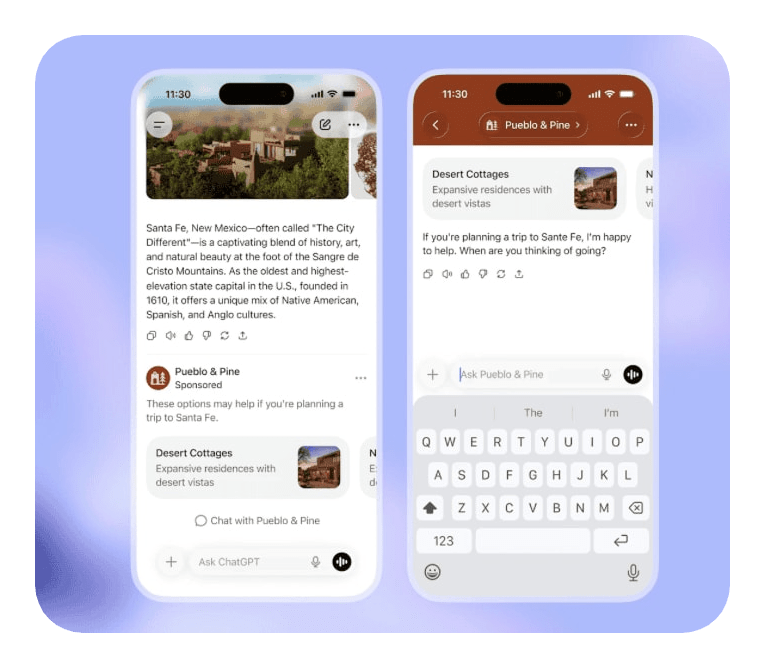
This signals the emergence of AI assistants as a potential new discovery channel for consumers and an acquisition vehicle for retailers.
Instead of relying solely on search engines or social platforms, brands may soon be able to reach high-intent consumers directly inside AI-generated recommendations.
Here’s what I think:
If conversational AI becomes a meaningful discovery layer, the way advertisers invest in retail media may need to evolve.
Rather than focusing purely on on-site retail media placements, brands may need to increase investment in off-site content that influences AI-generated answers.
Don’t forget, AI models frequently draw from trusted editorial and content sources when generating their responses. That creates an opportunity for content and affiliate partners to play a bigger role in product discovery.
Remember those high-quality editorial reviews, buying guides and comparison pieces that AI was supposed to kill off? They could increasingly influence what appears in AI-generated recommendations.
Luckily, many retailers are already experimenting with this approach. UK electronics retailer Currys, for example, has invested supplier budgets into off-site content partnerships designed to attract high-intent shoppers to key category pages, where on-site retail media placements can then convert the sale.
Content as an acquisition vehicle has had a rough time of late due to the onset of AI search chipping away at organic traffic. But ChatGPT’s move actually reinforces the value of trusted content environments as part of the wider retail media mix.
2. New CMA price transparency rules create homework for subscription marketers
Subscription brands like SimplyCook are a common fixture in brand partnership marketing placements.
Retailers often promote subscriptions at the basket stage to drive purchase completion. They’re also commonly used post-purchase to unlock a new revenue stream. In turn, those subscription brands acquire new customers at scale.
In Q1, the UK Competition and Markets Authority (CMA) brought some news right to their door.
From February 2026, the CMA introduced strengthened guidance around price transparency in consumer marketing. The updated rules require brands to clearly display the full price a customer will ultimately pay, including all ongoing charges and fees.
The regulator has specifically warned against “drip pricing,” where additional costs only become visible later in the purchase journey.
Over 100 businesses have been contacted directly, but this will be relevant for any subscription service that promotes free or discounted trials via brand partnerships.
Essentially, marketing messages such as “Free 30-day trial” must now also clearly communicate the price customers will pay once the trial ends.
While the updated rules are unlikely to deter their investments, subscription marketers will be required to provide clearer messaging within partner promotions and ensure any trial-based offer also clearly states the ongoing subscription cost.
Here’s what I think:
In practice, this could slightly reduce top-of-funnel acquisition volumes as messaging becomes more explicit. However, it may also improve customer quality and retention, as users are entering subscriptions with a clearer understanding of the long-term cost.
For brand partners, this could ultimately shift the value equation of referrals, with partners commanding stronger commercial terms for delivering more informed and higher-quality subscribers.
3. Secure browsing changes highlight the value of first-party retail media environments
Google is continuing its push towards a more secure web with the rollout of HTTPS-first browsing in Chrome.
Under this approach, the browser will attempt to load websites using secure HTTPS connections by default. If a site only supports HTTP, users will see a warning message before continuing.
While this change is primarily about improving user security, it also places additional pressure on the complex technology ecosystems that power modern digital advertising. For retail media, it’s big news.
Retail media networks often rely on multiple integrations including ad servers, demand-side platforms, data environments and measurement partners. Any element that relies on insecure HTTP requests risks triggering warnings or failing to load.
Retail media has grown rapidly because it combines closed-loop measurement with high-quality first-party data. Retailers know what customers browse and what they buy, making their environments and data extremely valuable for advertisers.
However, the more complex retail media ecosystems become, the more technical dependencies they introduce.
Here’s what I think:
Partner marketing can offer a simpler way for brands to access retailer audiences.
Through brand partnership placements, advertisers can reach shoppers directly within retailer environments without needing to integrate deeply into the retailer’s ad-tech stack or exchange customer data.
In many cases, the customer journey is straightforward. A shopper clicks a partner promotion and completes a transaction with the advertiser, with the sale tracked through the Awin platform.
As retailers continue to invest in their first-party data strategies, these kinds of direct brand partnerships are becoming an increasingly important complement to traditional retail media.
There’s plenty more where this came from
For more insights and analysis, and to explore the latest brand partnership opportunities on Awin, check our quarterly roundup.