Affiliate Fraud: How to Spot It and Protect Your Brand
Written by Edward Cranmer on 16 minute read
The warning signs of affiliate fraud, how each risk works, and how Awin helps protect your brand at network level.

Affiliate fraud is any tactic a partner uses to claim commission for sales, leads or clicks that were faked or would have happened anyway.
Affiliate marketing pays partners for results, so every sale should be credited to the partner who earned it. Fraud can sneak in and break that link, then you end up paying more for the same customers, and your data becomes skewed.
Fraud is easiest to deal with early. Catching a problem as it starts protects your budget, your partner relationships and your reporting. Clawing back commission weeks later takes far more time and effort.
Awin builds protection into the network, helping catch suspicious activity before it affects advertisers. This guide covers the main risks, the warning signs and how Awin helps you stay ahead of them.
Common affiliate fraud risks for brands
Affiliate fraud usually takes one of five forms. Each one exploits how affiliate marketing credits partners for sales, so a partner collects commission for value someone else created.
- Brand bidding: an affiliate bids on your brand name in paid search and earns commission on shoppers who were already looking for you.
- Ad hijacking: a partner copies your search ad so it looks like yours, then sends the click through their affiliate link.
- Voucher code leakage: an exclusive code spreads to voucher sites or browser extensions, where anyone can use it.
- Suspicious traffic: bots, click farms, cookie stuffing or fake leads inflate your clicks and conversions.
- Breaking programme terms: a partner uses unapproved keywords, ad copy or misleading claims, which can also breach advertising rules such as the CAP Code.
Each of these costs you twice: once in commission, and again in data you can no longer rely on. All of them can be managed with the right checks in place. The table below covers the four that hit budgets most directly, and how Awin helps with each.
Common affiliate risks and how Awin helps
| What it looks like | Why it matters | How Awin helps | |
|---|---|---|---|
| Brand bidding | Affiliate ads on your brand name | Commission on customers already looking for you | AdPolice monitoring for managed and selected clients |
| Ad hijacking | Copies of your search ads | Stolen clicks and credit | AdPolice monitoring for every advertiser |
| Voucher code leakage | Exclusive codes on public sites | Lost margin, wrong partner credited | Voucher Attribution locks codes to one partner |
| Suspicious traffic | Sudden spikes, bots, unusual sources | Paying for activity that isn't real | Compliance Team tools, IP Quality Score, SimilarWeb |
Source: Fraud prevention measures at Awin
Protecting your brand in search
Shoppers search for your brand name when they’re ready to buy. That makes your brand terms some of your most valuable traffic, and an easy target for partners chasing commission.
What brand bidding looks like in affiliate marketing
Brand bidding happens when an affiliate buys your brand name as a search keyword, so their ad sits above your own listing.
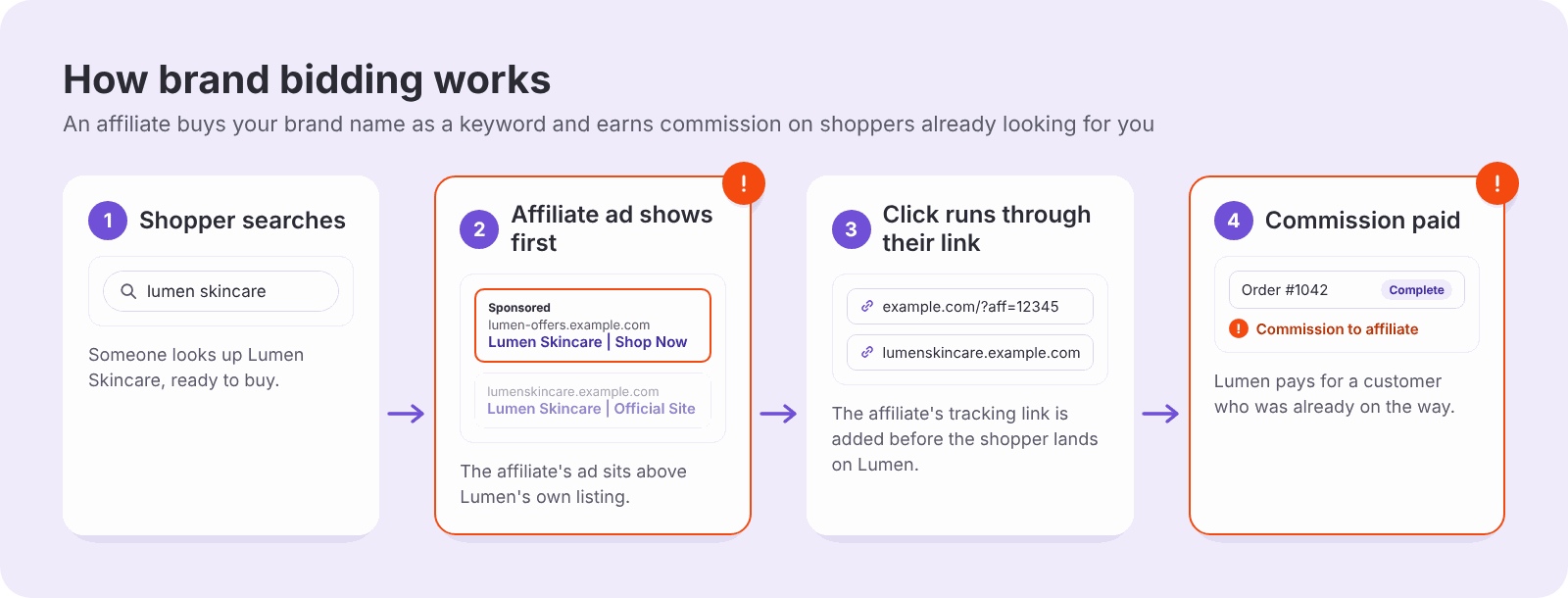
The cost goes beyond commission. Competing ads can push up the price of your own brand campaigns, and your reports credit affiliates with demand your brand created. Some brands allow brand bidding for named partners on agreed terms, so set your rules clearly in your programme terms.
How ad hijacking works
Ad hijacking goes further and copies the ad itself, down to your brand name, wording and web address.
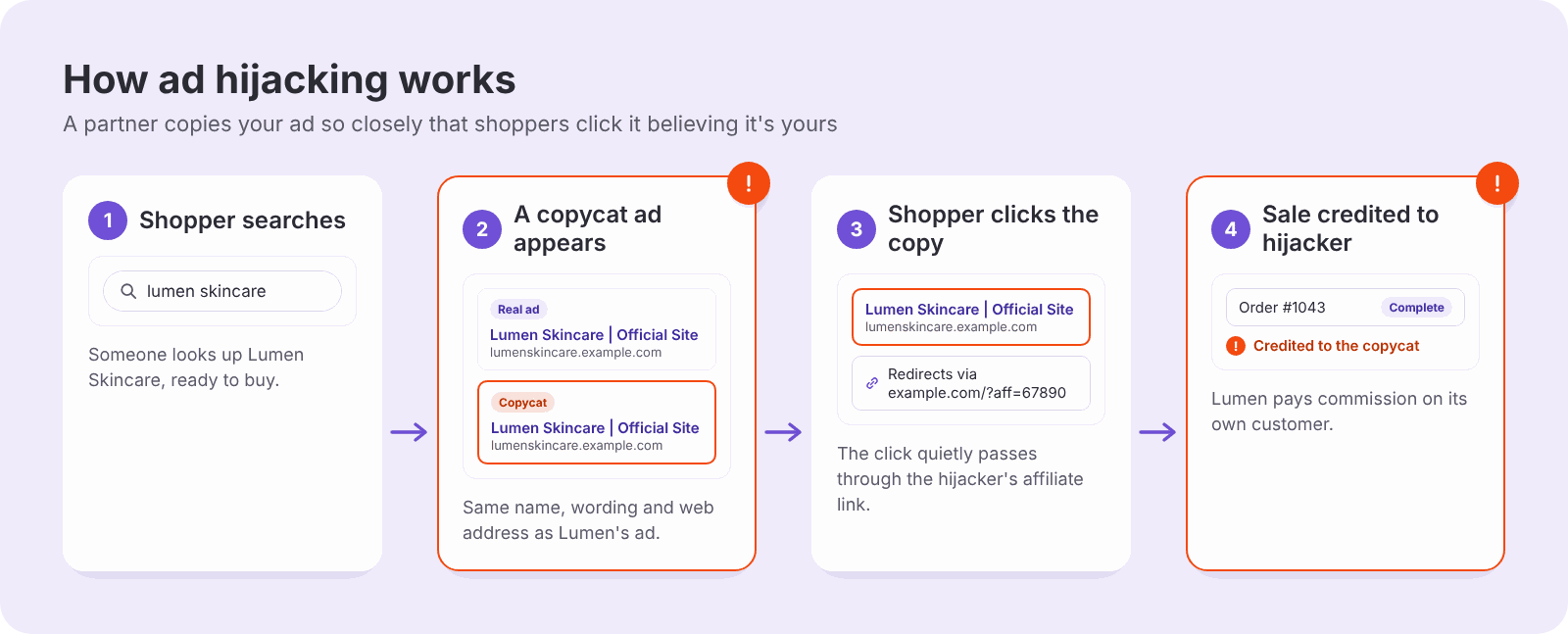
Shoppers rarely spot the difference, which makes hijacking hard to catch by checking search results yourself.
How Awin monitors paid search
Awin works with AdPolice to keep watch over your brand keywords across the main search engines.
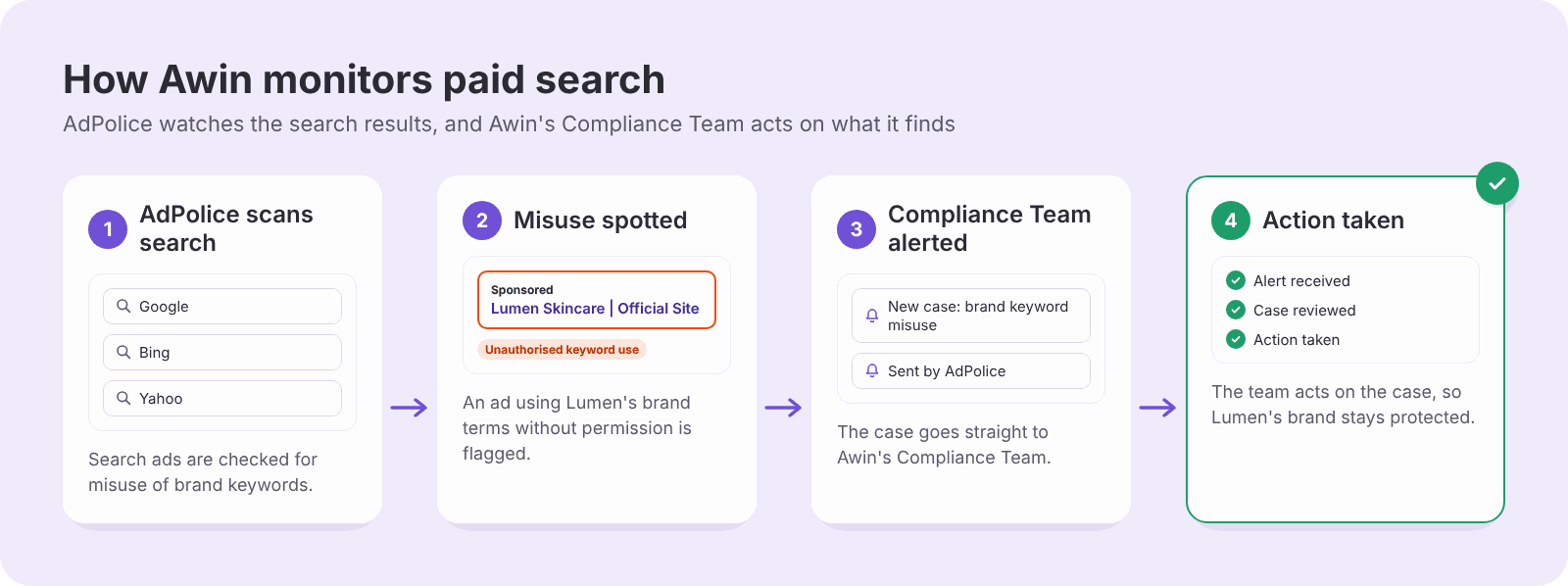
Ad hijacking is monitored for every Awin advertiser. Brand bidding is monitored for managed service clients and selected platform clients.
Stopping voucher code leakage
Exclusive codes are a great way to reward a partner and their audience. Once a code escapes that audience, it can turn up anywhere. Codes usually leak in one of four ways:
- Browser extensions pick up codes at checkout and offer them to other shoppers.
- Voucher sites collect codes they find online and repost them.
- Shoppers share their favourites on forums and social media.
- Simple codes like SUMMER10 are easy to guess.
The warning signs are easy to spot in your data. A code meant for a small audience suddenly drives far more orders, or sales start arriving from partners outside the original deal.
How Voucher Attribution keeps credit with the right partner
Voucher Attribution locks a code to one partner. Whenever a shopper uses that code, the sale is credited to the partner who owns it, wherever the shopper found it.
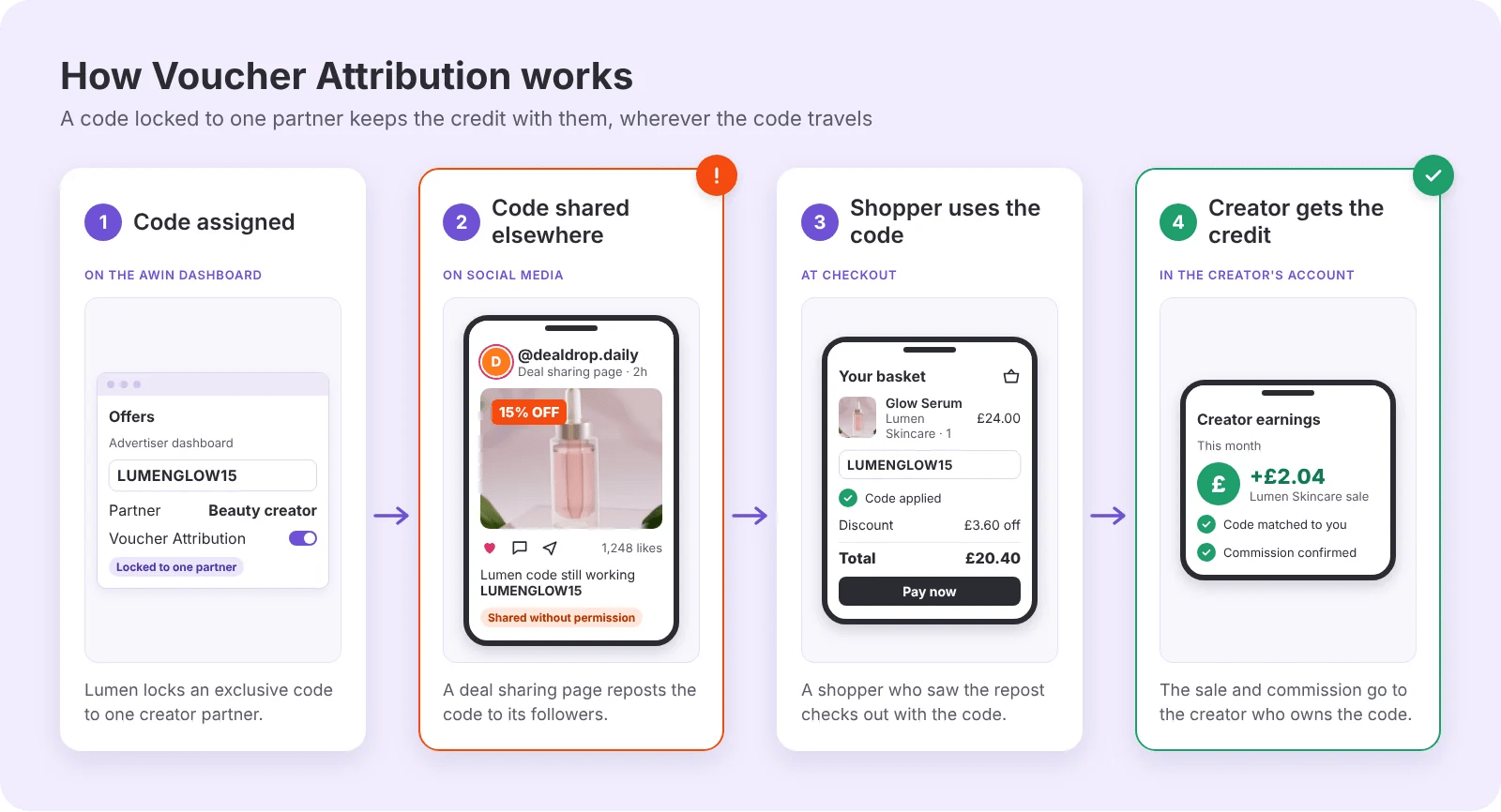
It also supports single use codes at scale, so exclusive offers stay exclusive. Voucher Attribution is live as a commission rule on Accelerate and Advanced plans.
For practical steps, such as short expiry dates and keeping an eye on unapproved codes in your Transactions report, see how to protect your programme against unauthorised voucher codes.
How Awin spots fraud early
Affiliate networks prevent fraud by checking who joins, watching traffic for anything unusual and acting quickly when something looks wrong. Awin does this with its own team and tools, backed by specialist third party tools.
What Awin’s own tools do
At the centre of Awin’s fraud protection is its Compliance Team, using tools built in house that run across the whole network.
- Network scanning: the Compliance Team actively scans the network for suspicious activity, using tools Awin developed itself.
- Compliance tracking reports: these reports help the team pick up anomalies in partner activity.
- Partner checks: partner activity is reviewed before and after approval.
- Content checks: regular reviews make sure partners’ promotional material and brand messaging follow each advertiser’s guidelines.
- Soft Click: Awin’s own safeguard for browser extensions, explained in the next section.
Specialist tools Awin uses alongside its own
Three specialist tools add extra coverage in search and traffic quality.
- AdPolice: monitors paid search ads on Google, Bing and Yahoo for unauthorised use of brand keywords and other partner activity that breaks the rules. When it finds a problem, it alerts the Compliance Team so they can act straight away.
- IP Quality Score: a fraud detection service that scores IP addresses for risk signals such as proxies, VPNs and bots, helping Awin detect fraud.
- SimilarWeb: analyses website traffic to flag sudden spikes, mismatches in where traffic comes from and possible bot activity.
Soft Click: fair credit when browser extensions join the journey
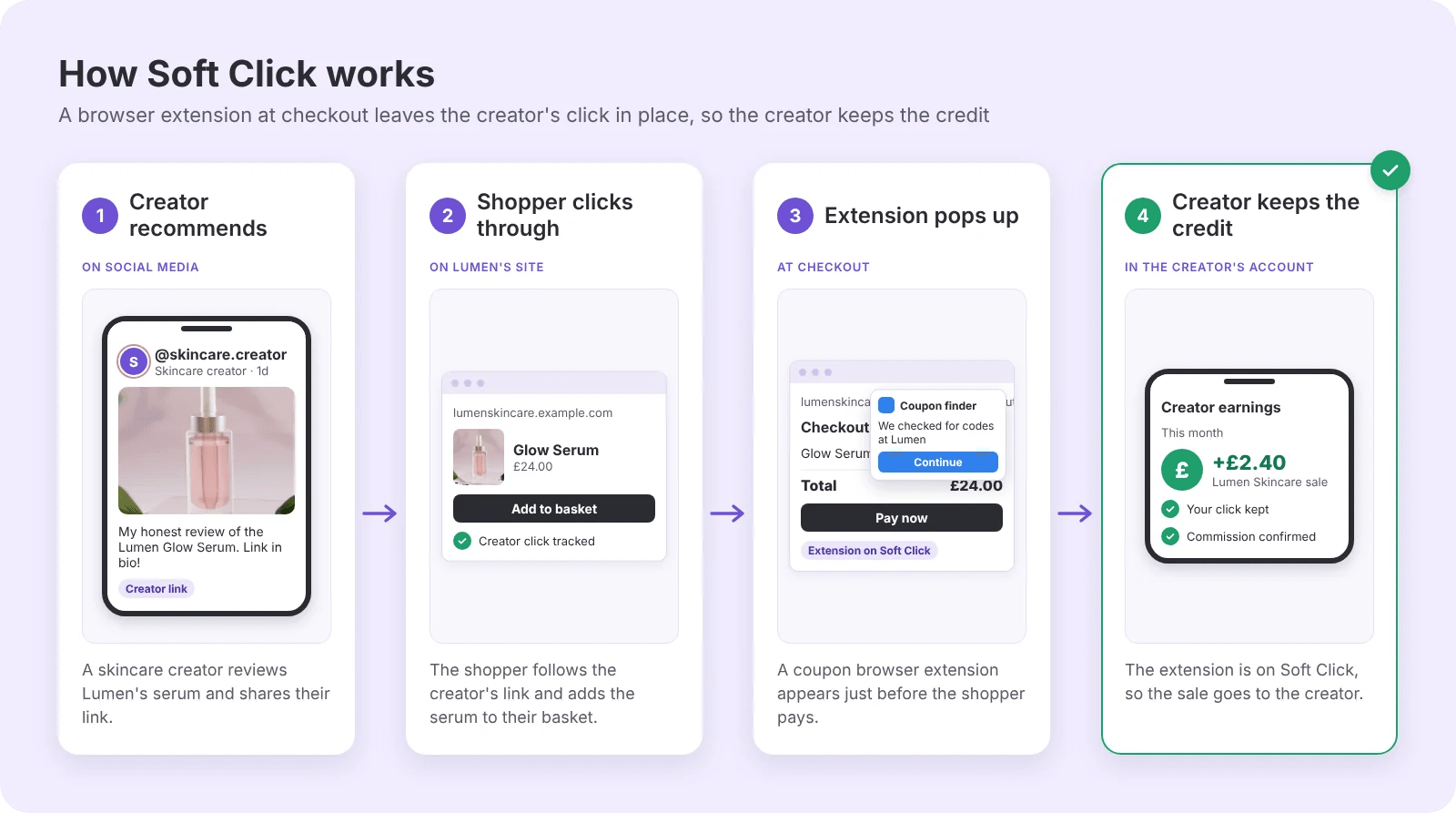
Browser extensions often step in at the very end of a purchase, just before checkout. Under last click rules, that final step could take credit from a creator or content site that did the real work.
Awin’s Soft Click technology keeps credit where it belongs. Partners running browser extensions must declare it under Awin’s Code of Conduct, and where appropriate they’re placed on Soft Click. Their cookies then leave those from influencers and content partners in place.
Red flags to watch for
You know your programme best, so a few signals are worth checking regularly. Here’s what each one can point to, and where Awin helps.
| What it can point to | How Awin helps | |
|---|---|---|
| Sudden traffic spike from one partner | Bots or bought traffic | SimilarWeb |
| Traffic from unexpected places | Disguised or low quality traffic | SimilarWeb, IP Quality Score |
| Conversion rate far above average | Brand bidding or ad hijacking | Compliance tracking reports, AdPolice |
| Sales from "[brand] voucher" searches | Brand bidding or leaked codes | AdPolice, Voucher Attribution |
| Exclusive code used far beyond its audience | Voucher code leakage | Voucher Attribution |
| Content partners losing sales to extensions | Last click overwriting | Soft Click |
Source: Fraud prevention measures at Awin
Choosing partners you can trust
The safest programmes start with the right partners. Partners on Awin are checked before joining and monitored on an ongoing basis, so you’re building on solid ground.
You still decide who joins your programme, so it’s worth checking a few things first:
- Look at how a partner promotes brands, including their site, social channels and audience.
- Read their Awin profile to see how they drive traffic. Browser extension partners on Soft Click are labelled there too.
- Start new partners on clear terms, then review their first few weeks of activity.
Your choice of network matters too. Our guide on how to choose an affiliate network covers what to look for, from partner quality to compliance support.
What brands can do themselves
Awin’s protections cover the network. These five habits cover your own programme, and most take minutes to set up.
- Set clear rules on brand bidding. Write into your programme terms exactly which search terms are off limits. Cover your brand name, common misspellings and combinations like “[brand] voucher” or “[brand] discount”, since shoppers type these just before they buy. For example: “Bidding on Lumen, Lumen Skincare or any misspelling of either in paid search is prohibited.”
- Say what happens when rules are broken. Set out the steps in your terms before you need them. A common sequence is a warning with evidence, then withheld commission on the affected sales, then removal from the programme. Partners know where they stand, and you can act quickly when it matters.
- Protect your codes. Give each partner its own code, named after them, so you can see at a glance where every sale came from. Lock exclusive codes with Voucher Attribution, and keep offer codes short lived or single use. Your Transactions report can flag unapproved codes in use.
- Watch busy periods closely. Peak trading like Black Friday brings far more traffic, which makes unusual spikes easier to hide. Around big sales, compare each partner’s clicks and conversion rate with a normal week, and look into anything that jumps sharply.
- Talk to Awin. Your Awin contact or the support team can walk you through the protections included in your plan and help you act on anything that looks off. Raise concerns as soon as you spot them, since a quick flag keeps less commission at stake.
Audits make a real difference. When PATTERN Beauty audited its affiliate programme, it removed a small group of partners engaging in brand bidding and ad hijacking, protecting its paid search channel and freeing up commission for content partners.
Common questions on affiliate fraud
What is affiliate fraud?
Affiliate fraud covers any tactic that lets a partner collect commission for sales driven by someone else, or for activity that was faked. Common examples include brand bidding, ad hijacking, leaked voucher codes, cookie stuffing and bot traffic. Each one means a brand pays for results the partner did little to create.
What is brand bidding in affiliate marketing?
Brand bidding in affiliate marketing is when an affiliate buys a brand’s name as a paid search keyword and sends the clicks through their own tracking link. Shoppers who were already looking for the brand click the affiliate’s ad first, so the brand pays commission on sales it was likely to make anyway.
What is ad hijacking?
Ad hijacking is when a partner copies a brand’s search ad, including its name, wording and web address, so the ad looks official. Shoppers click believing they’re visiting the brand directly, and the partner’s affiliate link takes the credit. Because the ad looks genuine, it can be hard to catch without monitoring tools.
How do I stop voucher codes leaking?
To stop voucher codes leaking, tie each exclusive code to one partner and keep offer codes short lived or single use. On Awin, Voucher Attribution keeps the credit with the partner who owns the code, wherever a shopper finds it. Check your Transactions report regularly for unapproved codes.
How does Awin protect advertisers from fraud?
Awin protects advertisers with its own Compliance Team and tools, working alongside specialist third party tools. The team scans the network for suspicious activity, while AdPolice monitors paid search, and IP Quality Score and SimilarWeb help flag fraudulent or unusual traffic. Features like Voucher Attribution and Soft Click keep credit with the right partner.
Ready to protect your affiliate programme?