How AI search boosts affiliate marketing and how to track it
Written by Edward Cranmer on 18 minute read
AI assistants are shaping what people buy. Here’s how brands and publishers can show up in AI answers, and how to track what it brings in.

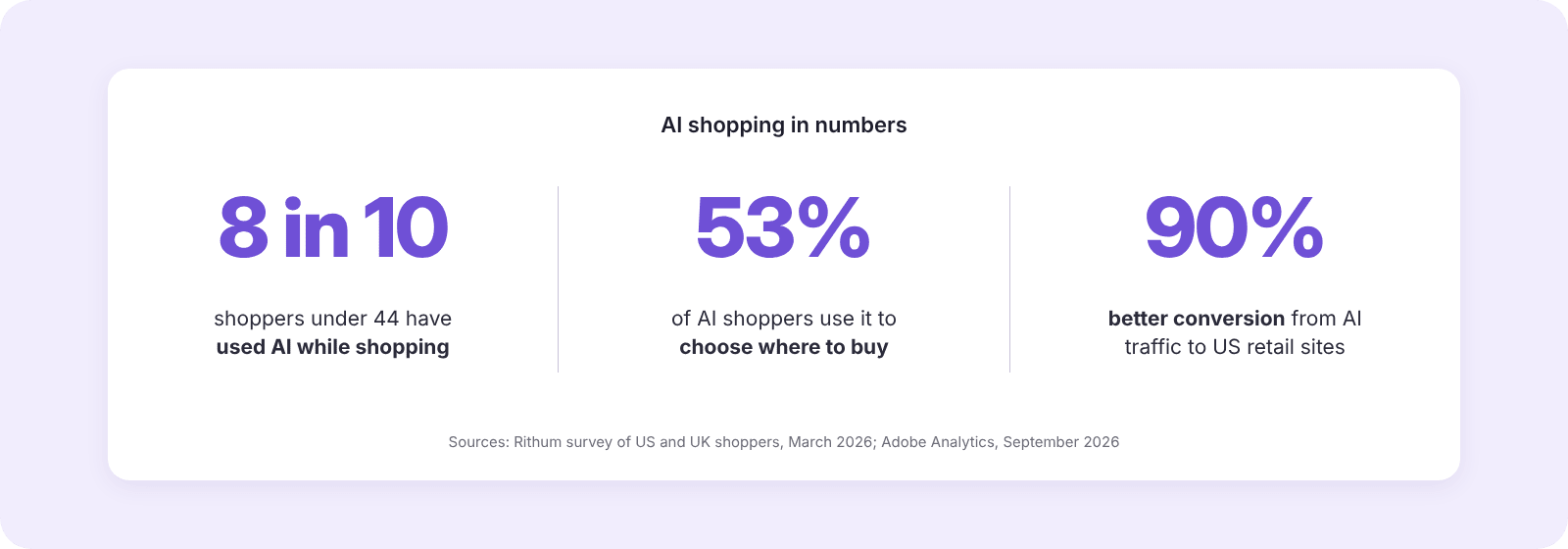
AI tools are already sending shoppers to affiliate partners. Across the UK, US, Germany and France, 0.2 to 0.5% of Awin affiliate sales now include a click from an AI tool, and baskets on those journeys are 27% to 119% bigger, according to Awin data published in July 2026.
It’s an early channel, and a growing one. It also rewards what affiliates already do well: honest reviews, side by side comparisons and up to date deals, the material AI assistants use to answer shopping questions.
This guide covers how AI search changes the path to purchase, how to get your brand into AI answers, and how to track the traffic and visibility that follow. For the wider picture, see our guide to AI in affiliate marketing.
What is AI search?
AI search is when people ask an AI assistant such as ChatGPT, Gemini, Perplexity or Google’s AI Mode a question and get a written answer that pulls the best options together. For shopping, that answer often names products, compares them and links to the sources it drew on, including affiliate sites.
For affiliate marketing, it changes where shoppers make up their minds and which content gets the credit.
How AI search changes the way shoppers find brands
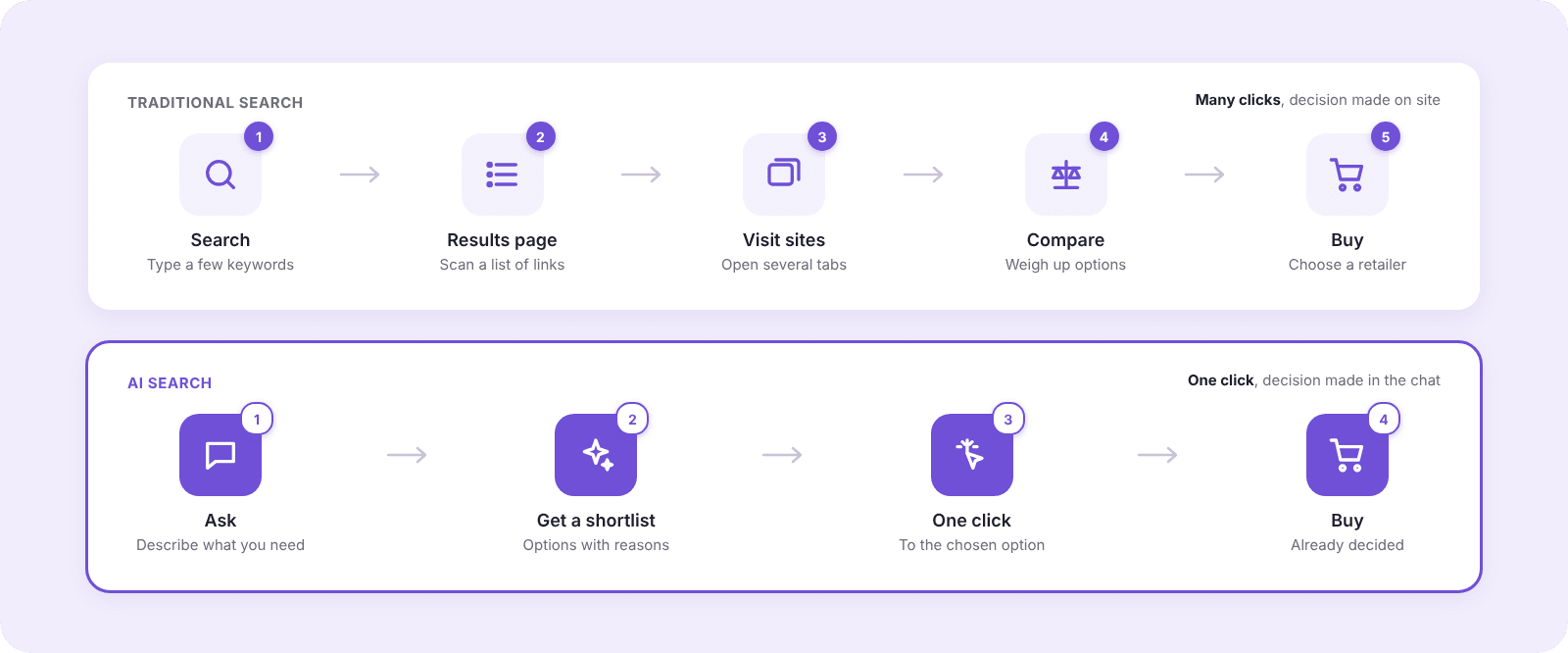
AI search folds several steps of shopping into one conversation. A shopper used to search, open a handful of sites, compare and then decide. Now they ask an assistant, get a shortlist with reasons, and often click only once, on the option they’ve already picked.
A Rithum survey of more than 1,000 US and UK shoppers shows how far this has gone. Among shoppers who use AI, more than 90% use it to research and compare products, and only 5% go on to check the details on a retailer or brand site.
The visits that do arrive are worth more. Adobe found that AI traffic to US retail sites brought in 83% higher revenue per visit than other traffic in September 2026.
For brands and affiliates, three things shift:
- Shortlists form before the click. If a brand isn’t in the answer, it may never be considered.
- Clicks fall while intent rises. Fewer visits arrive, and more of them are ready to buy.
- Attribution gets harder. Some AI journeys arrive with no clear referral and show up as direct traffic, which we cover in the tracking section below.
Why affiliate content carries more weight in AI answers
Reviews, comparisons and deal pages have long been the backbone of affiliate marketing. AI assistants now lean on that same content when they answer shopping questions, pulling product details, pros and cons, and prices from sites that cover them in depth.
Each type of affiliate content tends to play a different role in an AI answer:
| What AI uses it for | Why it matters for affiliates | |
|---|---|---|
| Product reviews | Pros, cons and real world performance | First hand testing gives AI reasons to recommend a product |
| Comparisons and best of lists | Building a shortlist of options | Brands featured in strong comparisons are more likely to make the answer |
| Buying guides | Explaining what to look for and who a product suits | Clear, structured advice is easy for AI to summarise |
| Deal and voucher pages | Current prices and offers | Shoppers asking for the best price need up to date offers |
Publishers gain influence as a result. When an assistant recommends a product, the reasoning often traces back to a publisher’s review. The trade off is fewer clicks, since some readers get their answer in the chat and never visit the page it came from.
AI shopping tools have even become a partner type of their own, with a dedicated category in Awin’s Power 100.
Brands benefit too. Rithum found that 1 in 5 shoppers have bought from a brand they’d never heard of because AI recommended it. Strong coverage from the right publishers can put a smaller brand in the same answer as a household name.
What GEO means for affiliate programmes
GEO, or generative engine optimisation, is the work of making your products and content easy for AI assistants to find, trust and recommend. In short, it’s about getting your products mentioned when someone asks an AI assistant what to buy.
For brands, it decides whether you show up when someone shops with an AI assistant:
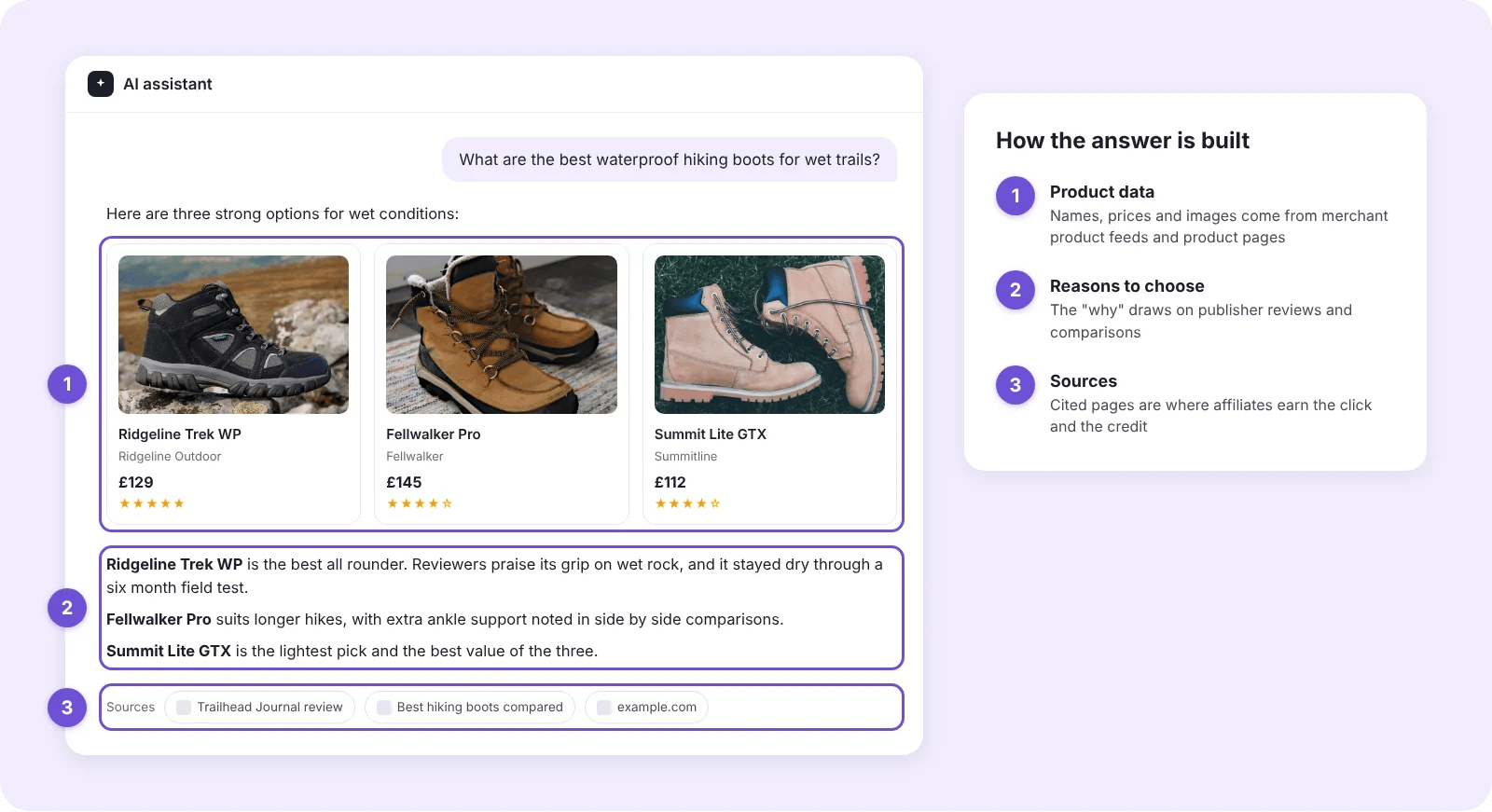
Every AI shopping answer draws on two kinds of source. Product data decides which products appear. Profound’s tracking found that by September 2026, product feeds supplied around 65% of ChatGPT Shopping recommendations.
Third party content explains why they made the shortlist. In a study of 60 product categories, publisher and review sites made up 59% of the sources AI tools cited, against 2.8% for brand owned pages.
Brands control the first. Their affiliate programme is how they influence the second.
GEO steps for brands
Your affiliate programme already holds most of what GEO needs: publishers who review your products and the product data they quote. These steps turn that into AI visibility, starting with knowing where you stand.
| What to do | Why it matters | |
|---|---|---|
| 1. Check where you appear | See which partner pages AI platforms read, and which publishers drive your visibility | Shows the gaps before you spend |
| 2. Get your product feeds right | Keep names, prices, stock and images accurate in Google Merchant Center and any feed you send to AI platforms | Feeds now supply most product picks in ChatGPT Shopping |
| 3. Fill coverage gaps | Recruit review and comparison publishers in categories where AI answers leave you out | AI cites third party sites far more than brand pages |
| 4. Support first hand reviews | Give partners samples, specs and access to product experts | Specific, tested detail gives AI a reason to recommend you |
| 5. Keep prices consistent | Match prices across your site, feeds and partner content | 58% of shoppers lose trust in a brand when AI gets details wrong |
| 6. Value cited content | Compare each partner's AI visits with the commission you pay them | A cited review can be worth more than its click count shows |
On Awin, AI Visibility covers the first step, and Smart Search helps with the third by finding publishers from a plain description of the coverage you’re missing.
GEO steps for publishers
Publishers write the content AI answers are built from, so small changes to how you structure and update it can decide whether your page gets cited or skipped. Most of these steps make content better for human readers too.
| What to do | Why it matters | |
|---|---|---|
| 1. Lead with the answer | Put your verdict in the first lines, and phrase headings the way people ask questions | Direct answers are easier for AI to lift and summarise |
| 2. Show your testing | Add original photos, measurements and real use notes | First hand detail sets you apart from generic summaries |
| 3. Use comparison tables | Lay out specs, prices and pros and cons in HTML tables | Structured comparisons are simple for AI to extract |
| 4. Cite your sources | Back claims with named data and dates | Research found adding sources and statistics can lift AI visibility by up to 40% |
| 5. Keep prices and dates fresh | Pull live prices from advertiser product feeds, and show when you last updated | Out of date deals undermine trust in the answer and in you |
Brands increasingly notice which partners drive their AI visibility, so being the cited source is becoming a reason for brands to choose you.
How to track traffic from ChatGPT and other AI platforms
Most AI visits reach your site as referrals from a handful of domains, such as chatgpt.com, perplexity.ai, gemini.google.com and claude.ai. Google Analytics 4 added a built in AI Assistant channel in May 2026, covering ChatGPT, Gemini, Copilot, DeepSeek and Grok. Perplexity and Claude still land in Referral, so a custom channel group gives you the fuller picture.
Set up an AI channel in GA4
It takes about five minutes, and you only do it once.
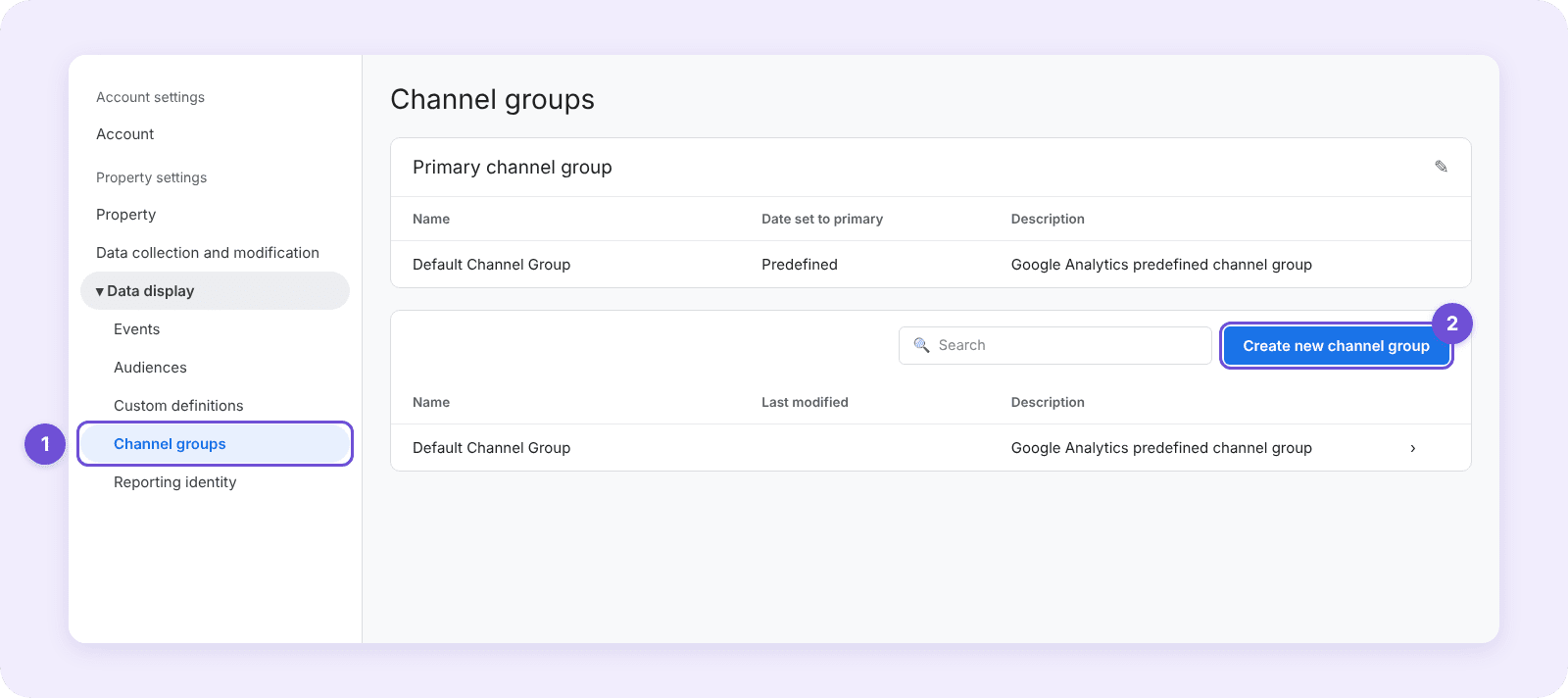
1. Open Channel groups. In Admin, go to Data display, then Channel groups.
2. Create a new group. Select Create new channel group, give it a name such as “Default + AI assistants”, then select Add new channel.
3. Name the channel. Call it AI assistants.
4. Add the condition. Set Source to matches regex, then copy this pattern into the box. It tells GA4 which websites count as AI assistants:
COPY THIS PATTERN
(^|\.)(chatgpt\.com|chat\.openai\.com|perplexity\.ai|claude\.ai|gemini\.google\.com|copilot\.microsoft\.com|deepseek\.com|grok\.com)$
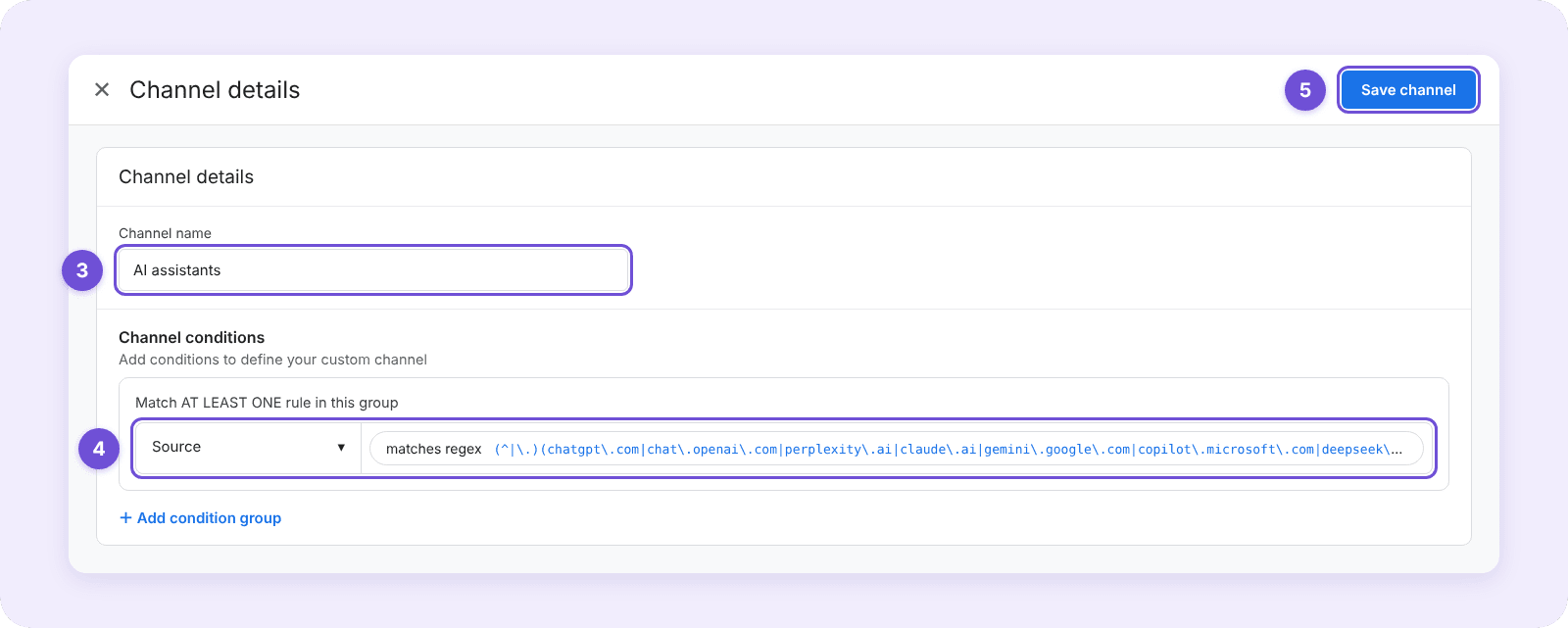
5. Move it to the top. Select Reorder and drag AI assistants above Organic Search and Referral. GA4 assigns each visit to the first channel that matches.
6. Save the group.
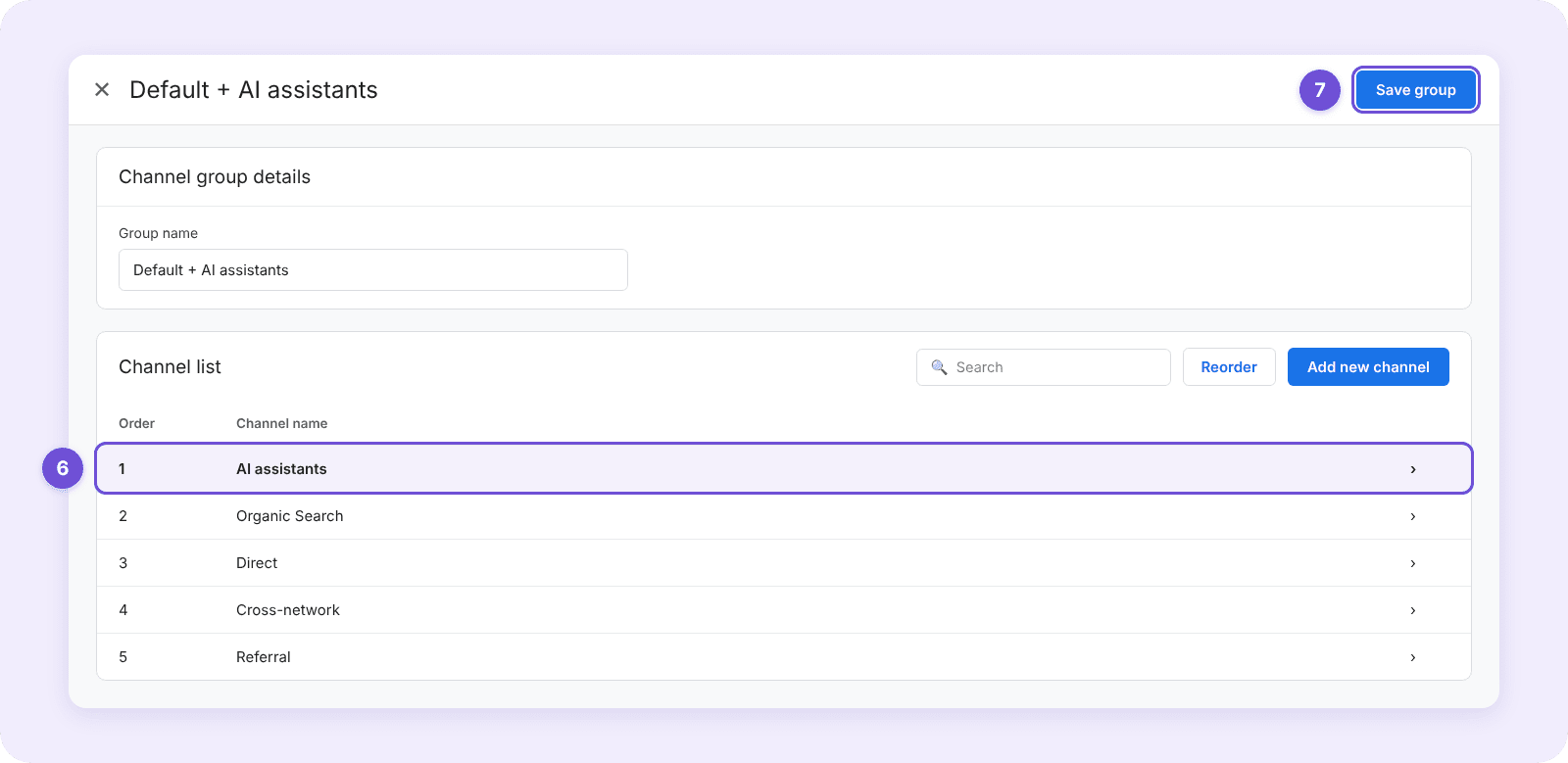
7. Make it your primary group. Back on Channel groups, select the pencil next to Primary channel group and choose your new group. Reports now show AI assistants as its own channel.
Once it’s live, compare AI traffic’s conversion rate and revenue per session with your other channels, as well as its size.
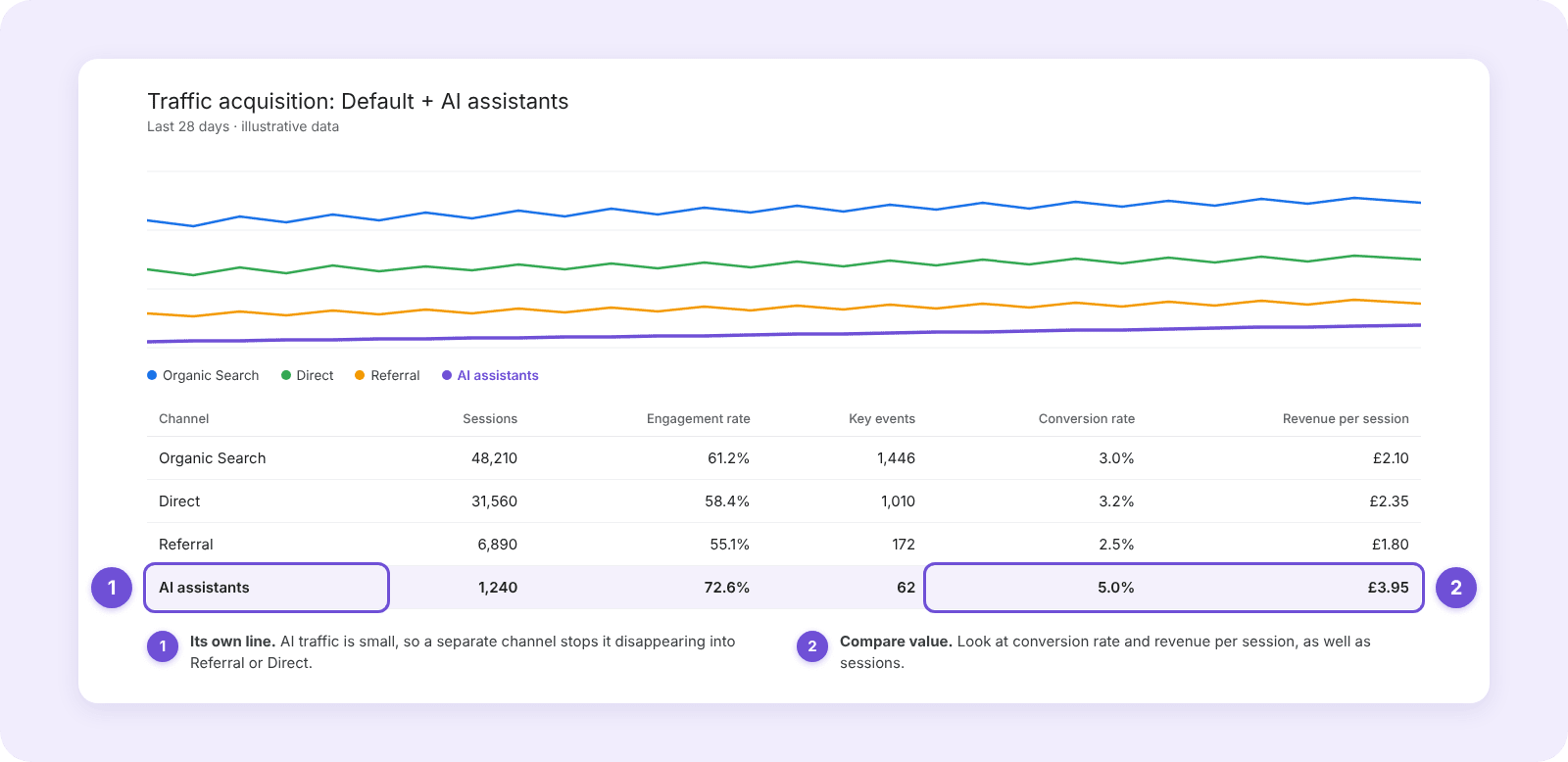
Treat the numbers as a minimum. Visits from AI mobile apps often arrive with no referrer and land in Direct, and Google’s own AI Overviews and AI Mode are counted as Organic Search.
See what AI traffic does for your affiliate programme
GA4 shows that AI visits happened. For affiliate programmes, the next question is what those visits led to, and which partners were part of the journey.
Journey Path now includes AI driven traffic, showing how interactions from AI platforms contribute to conversions across the customer journey. It’s available on Accelerate and Advanced plans, and the Journey Path guide explains how to read it.
Measuring brand visibility in AI answers
Traffic only counts the shoppers who click. Many people read an AI answer and act on it without visiting a site, so the other half of measurement is visibility: how often AI draws on content about your brand, and where that content lives.
There are two main ways to measure it. Prompt tracking tools run a set of shopping questions through assistants on a schedule and record what comes back. The other approach looks at which pages AI platforms visit and read, which shows the content shaping their answers.
AI Visibility on Awin
Awin’s AI Visibility takes the second approach. It’s based on AI visits to your partners’ pages, and it shows which partners are increasing your brand’s visibility in AI answers and discovery journeys.
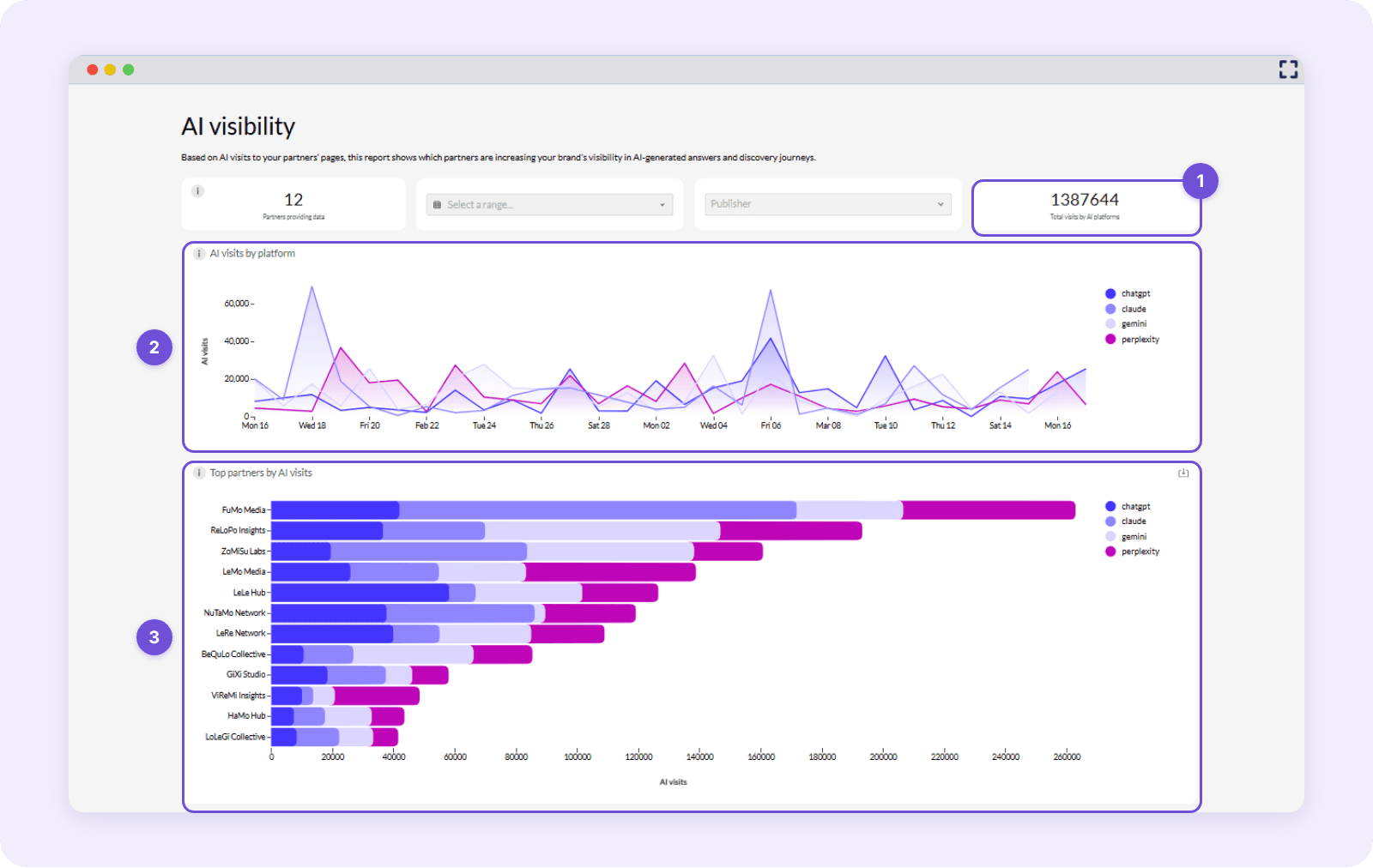
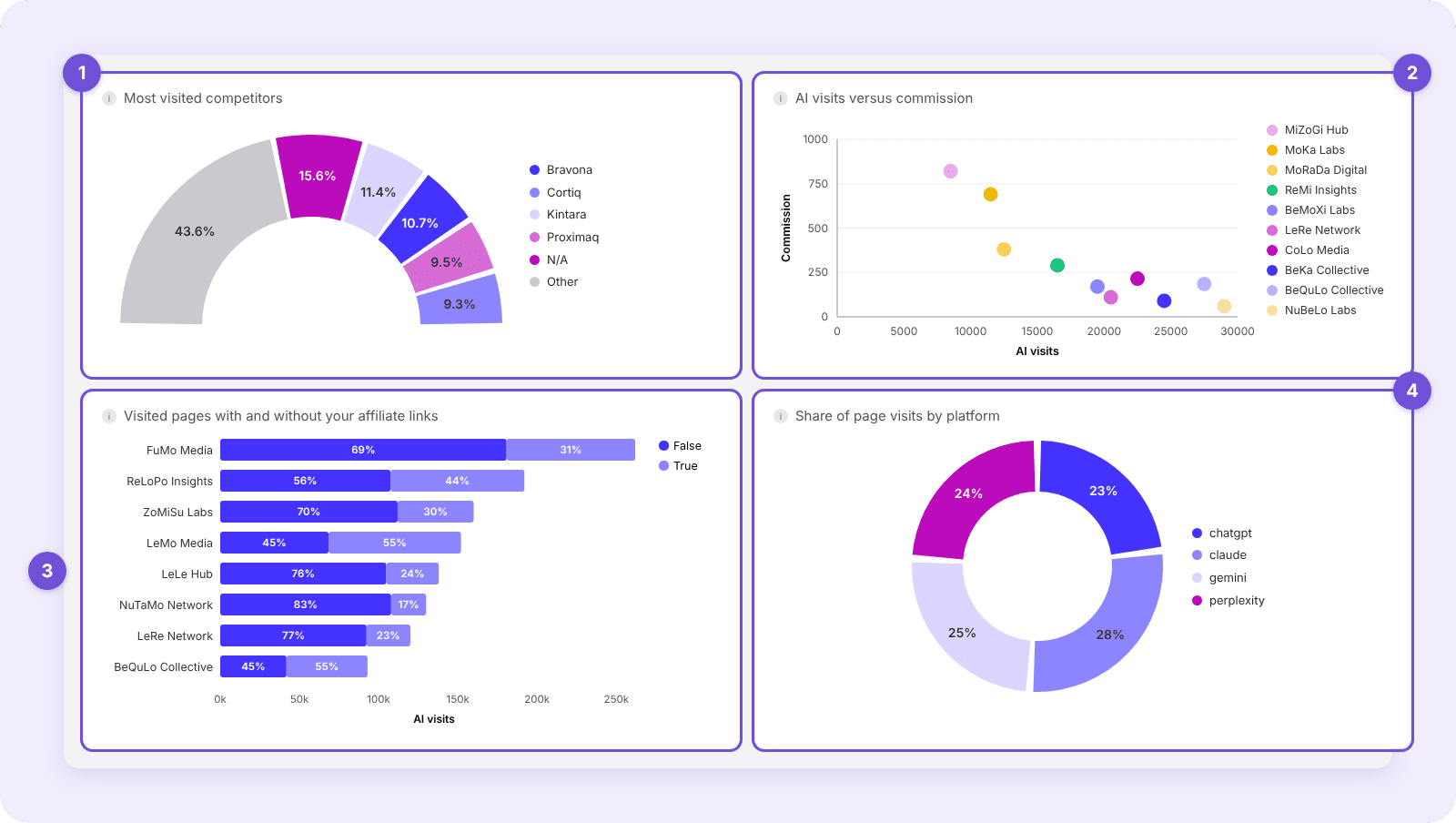
The overview shows how many AI visits your partners’ pages receive, which assistants they come from, and which partners and pages AI relies on most. It also splits visits by reason, whether search, agentic tasks or model training, so you can separate visits tied to live answers from background training.
Use it to set priorities. The partners at the top of the list are already shaping how AI describes your products, so they’re the first to brief, support with product detail and keep supplied with accurate offers.
Four more views turn that visibility into action:
| What it tells you | What to do with it | |
|---|---|---|
| 1. Most visited competitors | Which rival brands appear on the same pages AI reads | Spot where competitors are winning coverage |
| 2. AI visits versus commission | Partners whose AI influence is high compared with what you pay them | Review commission for your most influential partners |
| 3. Pages with and without your links | Partner pages AI reads that don't yet link to you | Ask those partners to add your links |
| 4. Share of visits by platform | How AI visits split across ChatGPT, Claude, Gemini and Perplexity | Check whether one platform dominates, or visits are spread evenly |
Together, these views tie AI visibility to decisions you already make: which partners to recruit, what to pay them and which content to prioritise. Here’s how they look in the report:
For publishers, the same data shows how their content influences AI discovery, even when a reader never clicks. That gives them a clear way to show brands the value of their coverage.
AI Visibility and AI traffic in Journey Path are both included with Accelerate and Advanced plans, so it’s worth checking which tools come with each when you compare Awin’s plans.
Common questions on AI search and affiliates
How does AI search affect affiliate marketing?
AI search shortens the path to purchase, so shoppers compare and choose inside one conversation. Fewer clicks reach websites, and the ones that do are more likely to buy. AI answers also draw heavily on reviews and comparisons, which puts affiliate content at the centre of what shoppers see.
How do you get your brand mentioned in AI answers?
Start with accurate product data in your feeds, then make sure trusted publishers cover your products in depth. AI tools cite publisher and review sites far more often than brand pages, so strong affiliate coverage is one of the most reliable ways to appear. First hand testing and clear, structured content help too.
Can you track ChatGPT traffic in GA4?
Yes. GA4 has a built in AI Assistant channel, and a custom channel group with a regex covers platforms it misses, such as Perplexity and Claude. Treat the result as a minimum, since some AI app visits arrive without a referrer and land in Direct.
What tools track brand visibility in AI answers?
Two types of tool do this. Prompt tracking tools run shopping questions through assistants and record which brands appear. Awin’s AI Visibility takes a different route, measuring AI visits to your partners’ pages to show which publishers shape your visibility, on Accelerate and Advanced plans.
Is SEO still worth it with AI search?
SEO still matters, because AI assistants draw on the same well structured, trusted pages that rank in search. Its focus has widened to clear answers, original detail and accurate product data, which help content get cited in AI answers as well as ranked.
See how your brand shows up in AI search