Affiliate Attribution Models: Choosing the Right One
Written by Edward Cranmer on 25 minute read
Your attribution model decides which partner earns commission. Here is how each one works and how to choose for your programme.

Affiliate attribution models are the rules that decide which partner earns commission when more than one partner is involved in a sale. On Awin, the standard is "last contact wins" with a cookie hierarchy: the most recent click earns the commission, and a click outranks an ad view.
In affiliate marketing, credit comes with a payment. Your model decides which partners earn from the sales they help create, and over time that shapes who promotes your brand and how they do it.
This guide explains how each model works and how to choose the one that fits your partner mix and goals.
What an attribution model decides in affiliate marketing
Take a customer who clicks a creator's post about linen bedding, then a review site's bedding guide, then a cashback site at checkout, and spends £120.
That's the basis of how affiliate marketing works: partners earn commission when their tracked link leads to a sale. When three tracked links lead to one sale, the attribution model decides which partner earns the commission, or how it's shared.
The same journey pays out differently depending on the model. Under last click, the cashback site earns the commission. Under first click, the creator does. Under a linear model, each partner earns a third.
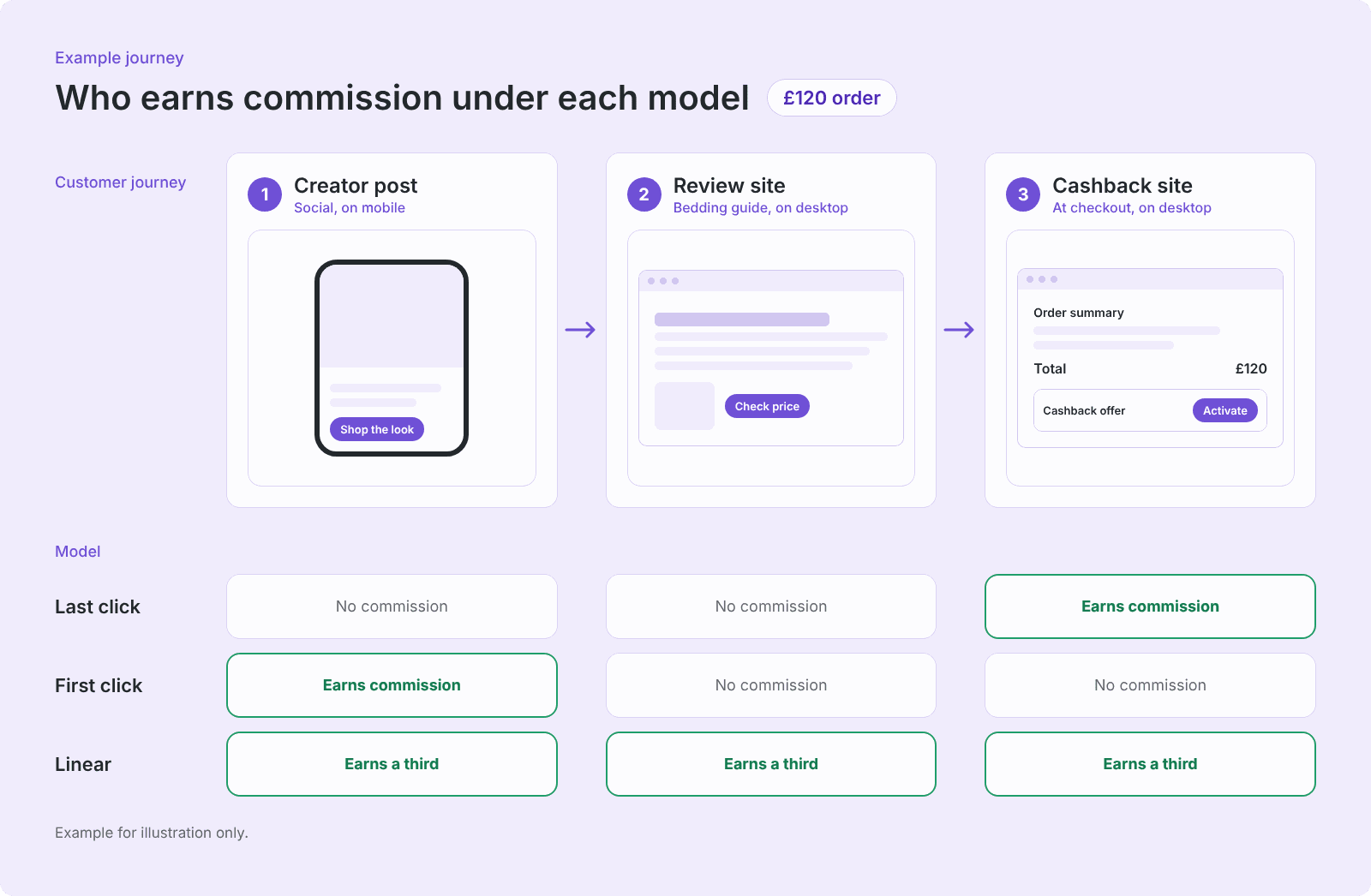
Attribution models do two jobs. As a commission rule, a model sets who gets paid. As a reporting view, it shows how credit would fall under a different rule without changing anyone's earnings. Paying on one model and reporting on others lets you see the effect of a change before your partners feel it.
The six affiliate attribution models
Six models cover the options you'll find in affiliate programmes and analytics tools. Each one credits a different click, or set of clicks, as shown below.
| Model | How commission is assigned | What it rewards | What to watch for |
|---|---|---|---|
| Last click | All of it to the final affiliate click before purchase | Partners who help customers complete a purchase | Earlier partners earn only when they also send the last click |
| First click | All of it to the click that started the journey | Partners who introduce customers to your brand | Partners closer to purchase earn only when they were also first |
| Linear | Split equally across every affiliate click | Every partner involved in the journey | Equal shares leave out how much each click contributed |
| Time decay | More to clicks closer to the purchase | Partners near the sale, with a share for earlier ones | Partners who start the journey receive the smallest shares |
| Position based | Commonly 40% to the first click, 40% to the last and 20% shared across the middle | Partners who start and finish the journey | Partners in the middle share the smallest portion |
| Data driven | Weighted by patterns in your own conversion data | Partners whose clicks appear to contribute most | Needs steady conversion volume and full journey tracking |
The first two models pay a single partner, the next three share commission using a fixed formula, and data driven attribution sets its weights from your own sales.
Last click and first click
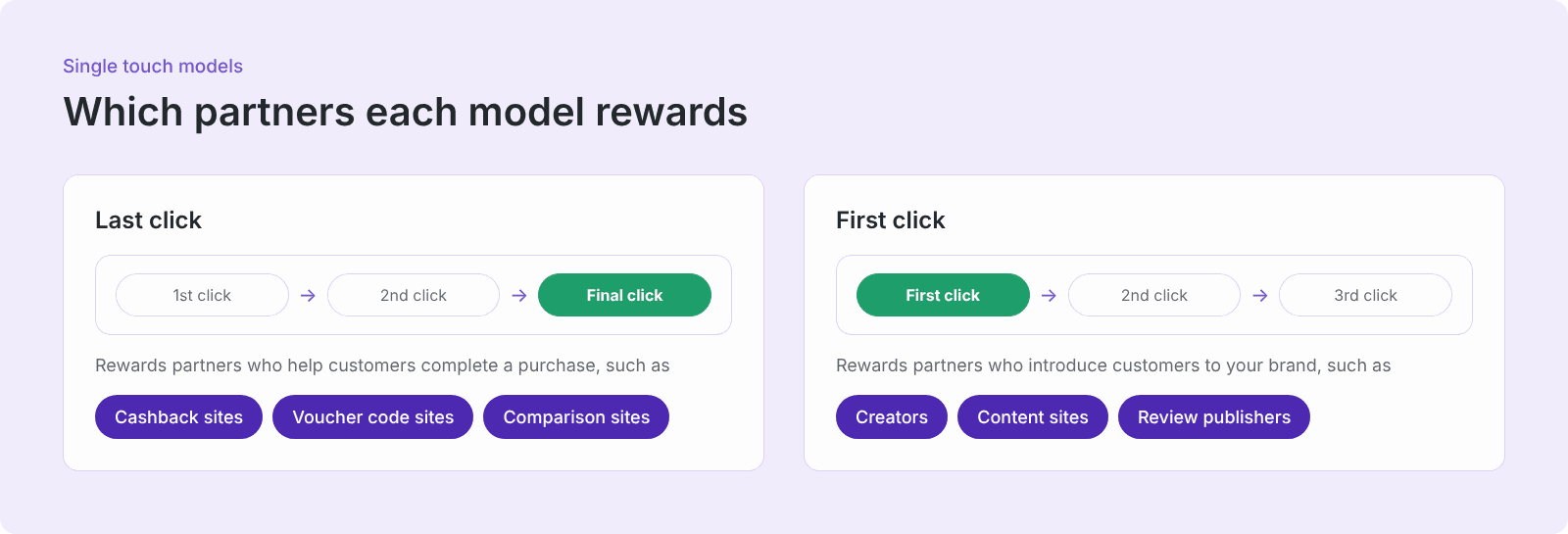
Both are single touch models: one partner earns the full commission. Last click credits the final affiliate click before purchase. It's the standard on Awin, and partners understand it quickly because whoever sends the customer last earns. It rewards partners who help customers complete a purchase, such as cashback, voucher code and comparison sites. Partners who introduce your brand earn when they also send the final click.
First click credits the partner whose click started the journey. It rewards discovery partners such as creators, content sites and review publishers, and suits brands focused on reaching new customers. Partners who help close the sale earn when they were also first.
Linear, time decay and position based
These rules based multi touch models share commission across every partner in the journey using a fixed formula. Linear splits it equally. Time decay gives more to partners closer to the purchase, while earlier clicks still earn a smaller share.
Position based weights the first and last clicks most heavily, and the common U shaped version gives 40% to each and shares the remaining 20% across the middle.
At 10% commission, that £120 order pays £12. Here's how each model splits it across the three partners.
| Model | Creator (first click) | Review site (middle click) | Cashback site (last click) |
|---|---|---|---|
| Linear | £4.00 | £4.00 | £4.00 |
| Time decay | £2.00 | £4.00 | £6.00 |
| Position based | £4.80 | £2.40 | £4.80 |
Example figures. Time decay uses an example weighting.
Data driven attribution
Data driven, or algorithmic, attribution sets each partner's share from your own conversion data. It compares journeys that converted with those that didn't, then weights each touchpoint by how much it appears to contribute. The weights update as your partner mix changes.
To be reliable, the model needs a steady volume of conversions and tracking that captures the full journey. It's also harder to explain to partners than a fixed rule, so share the principles behind it when you introduce it.
On Awin, SingleView is a data driven multi touch attribution platform that runs through the Advertiser MasterTag. It's an add on, and it powers the attribution performance report covered later in this guide.
How a cookie hierarchy ranks partners under last click
A cookie hierarchy sits on top of last click and sets which kinds of click are allowed to win. Each affiliate click sets a cookie in the customer's browser, and affiliate tracking explains how those cookies record the sale.
Without a hierarchy, every new click replaces the last one, whatever role the partner played. Awin introduced its cookie hierarchy in 2010 so different partner types can work on the same programme and each is credited for the part it plays.
The cookie types and the order they win in
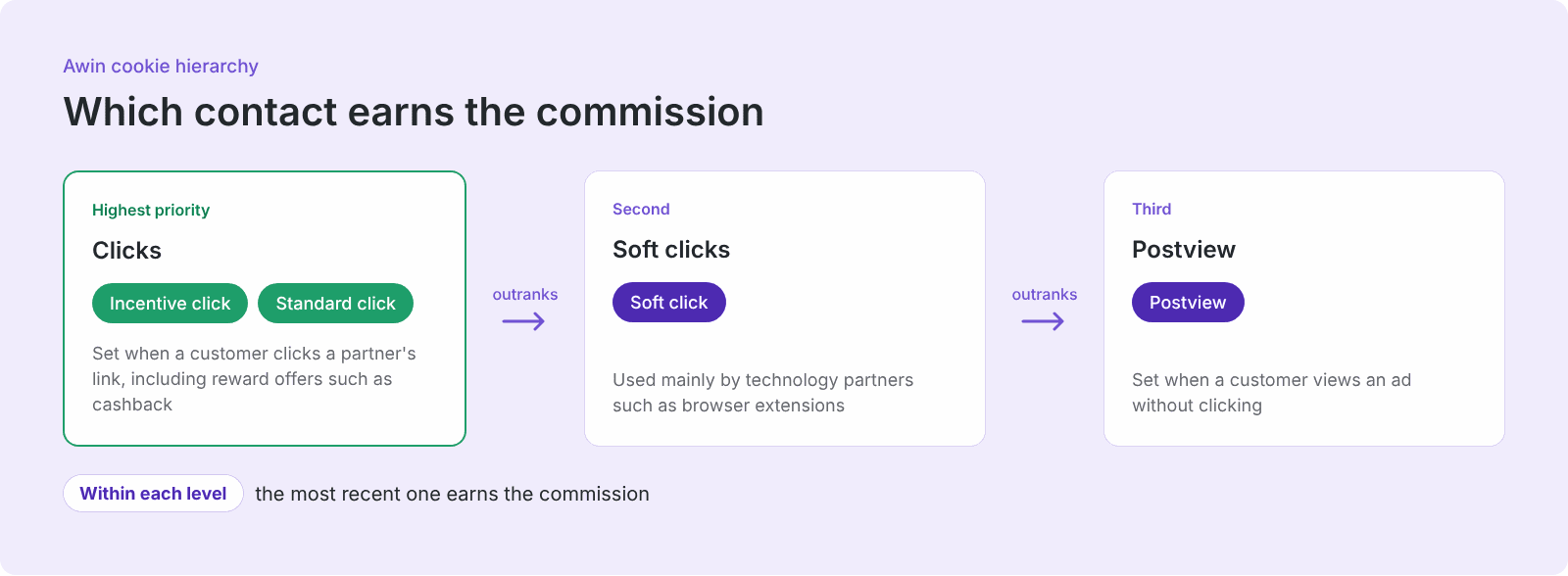
Awin uses four cookie types:
- Incentive click: set when a customer engages with a reward, such as cashback.
- Standard click: the most common affiliate click.
- Soft click: a lower priority click used mainly by technology partners.
- Postview: set when a customer views an ad without clicking.
Clicks outrank soft clicks, and soft clicks outrank postview. Within the same level, the most recent one earns the commission.
Where Soft Click fits
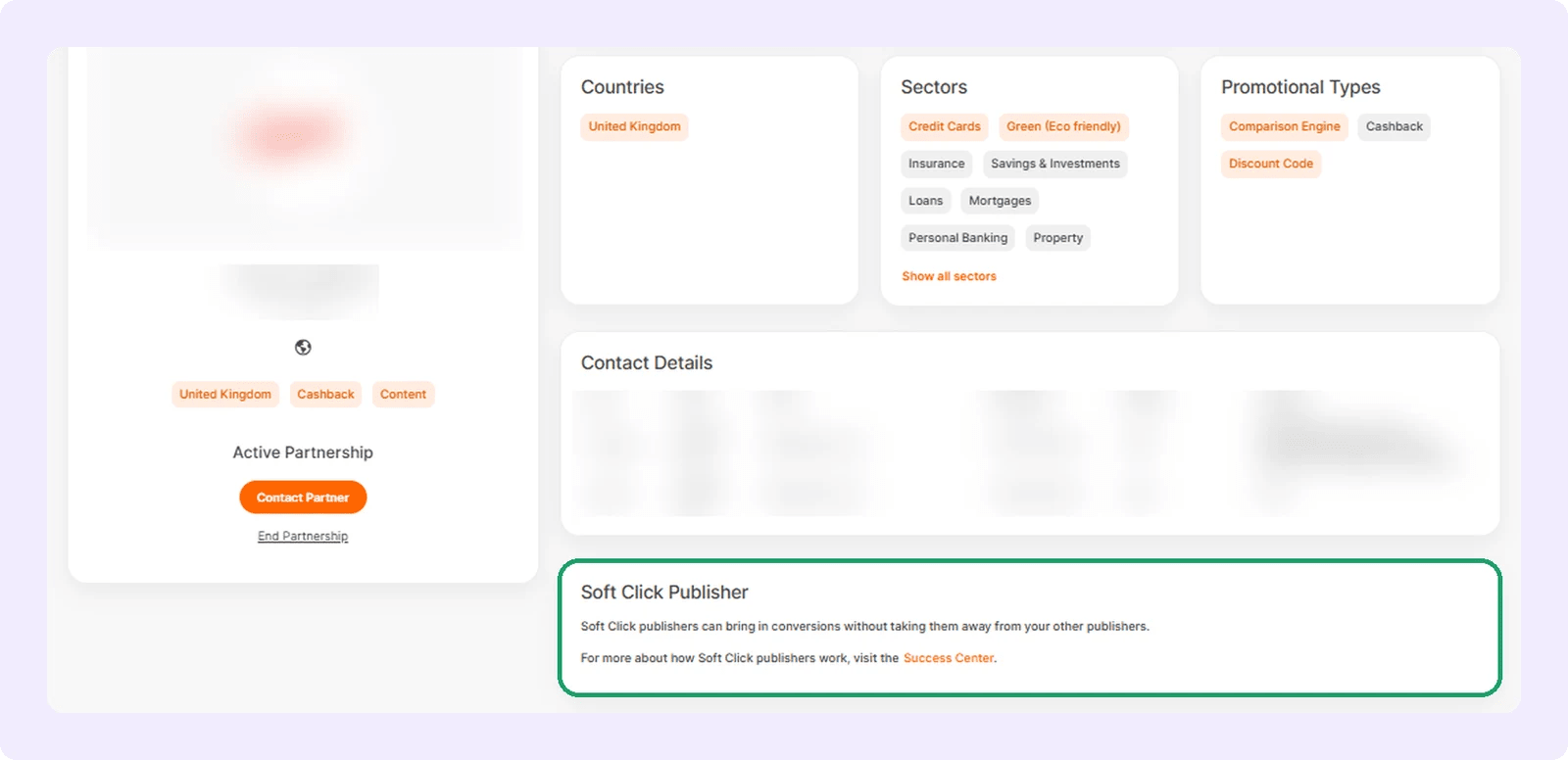
Soft Click is Awin's setting for browser extensions. Their cookies don't override cookies from creators and content partners. A Soft Click partner earns commission when it's the only click in the journey, or the last click when the only other click came from another Soft Click partner.
Publishers with browser extensions must declare them under Awin's Code of Conduct, and are placed on Soft Click where appropriate. Each advertiser sets its own attribution rules and can choose not to apply it. You can check a partner's status on its profile, and the Soft Click guide covers the detail.
How de-duplication settles sales between channels
Attribution models decide which partner earns within your affiliate programme. De-duplication decides whether the affiliate channel earns at all when another channel, such as paid search or email, played a part in the same sale. It credits each order to one channel, so you pay for it once.
Say a brand also runs paid search. A customer clicks a cashback site, then a paid search ad, then buys.
If the brand de-duplicates on last referrer, paid search takes the sale and no affiliate commission is due. If the order of clicks were reversed, the cashback site would earn.
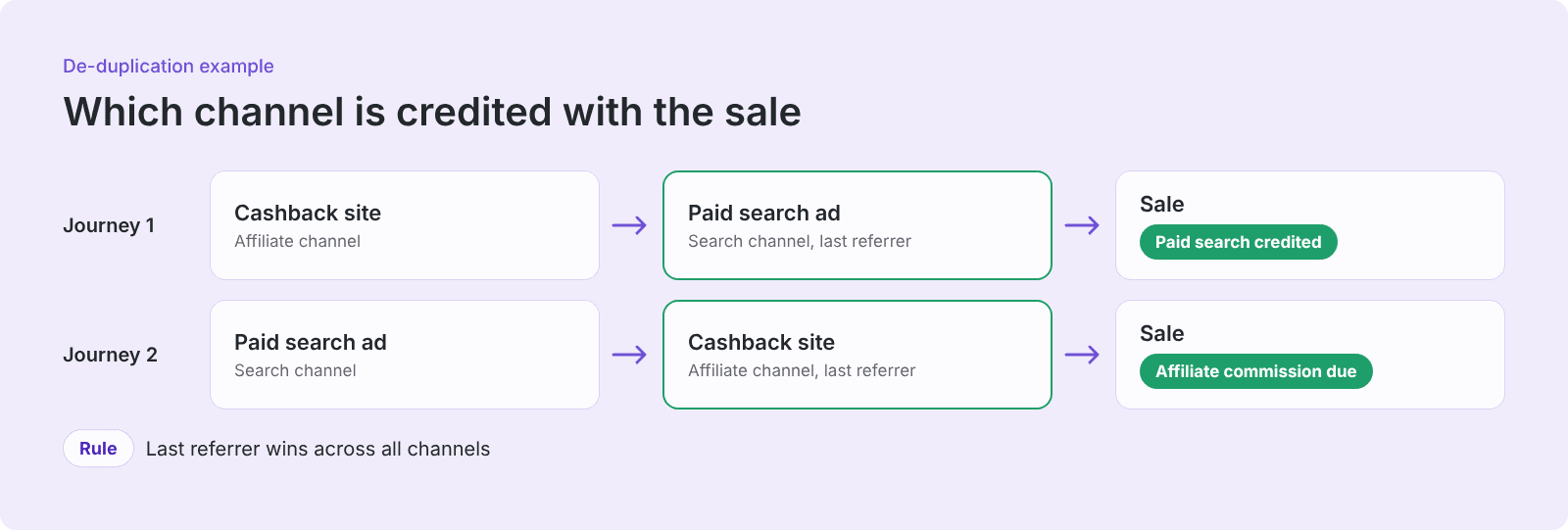
Awin's recommended setup is conditional tagging. Each channel adds a source parameter to its landing page URLs, a cookie stores the last referrer, and the confirmation page fires the tag for that channel only. Within the affiliate channel itself, Awin de-duplicates automatically, unless you also run partners on another network.
Two settings shape how much this affects your partners:
- Which channels take priority. A sale with a click from a higher priority channel won't pay affiliate commission.
- How far back the rule looks. A longer lookback for other channels removes more sales from the affiliate channel.
Awin asks advertisers to set out their de-duplication policy in their programme terms, where partners can see it. Clear terms let partners understand what they'll be paid for before they start promoting you.
How to choose the right attribution model for your programme
The right model depends on what you want your affiliate programme to do, which partners you rely on, and the data you can collect. Start with your goals, check your tracking, then measure before you change how anyone is paid.
Start with your partner mix and goals
Look at where your partners sit in the journey and what you want more of. Reaching new customers relies on partners who introduce your brand, and conversion relies on partners close to checkout. Many programmes use both, in different proportions.
A brand that wants to grow creator partnerships without losing its cashback partners might choose a position based view, because it credits the partners who start the journey and those who finish it.
This table matches common goals to the models that fit them.
| Your goal | Model that fits | What you need in place |
|---|---|---|
| A simple rule every partner understands | Last click | Standard affiliate tracking |
| Reaching new customers | First click | Tracking that records the first affiliate touchpoint |
| Rewarding partners who start and finish journeys | Position based | Full journey tracking |
| Short promotions and sales events | Time decay | Full journey tracking |
| An even view across a wide partner mix | Linear | Full journey tracking |
| Weighting partners by their measured contribution | Data driven | Full journey tracking and a steady volume of conversions |
Check whether you have the data to support it
Every model beyond last click needs a record of each partner in the journey and the order they appeared in.
On Awin, that record comes from the Advertiser MasterTag, which sets a first party cookie on your site. Journey reports and SingleView are built on it, so it needs to be on every page. Server to server tracking adds a record that doesn't rely on browser cookies.
Data driven models also need volume. With only a few sales a month, the weights can swing from order to order, so a fixed rule is the steadier choice until volume grows.
Measure before you change anything
Awin's journey reports show how partners contribute beyond the last click:
- Journey Path shows every touchpoint behind each sale, including traffic from AI platforms. AI search covers that in more detail.
- Funnel shows which partners start, support and close journeys.
- Publisher Crossover shows sales involving more than one partner.
To test whether a partner drives sales that wouldn't happen otherwise, look at incrementality (bold placeholder for the planned spoke). For the wider picture, see measuring affiliate performance.
Here's where each report is available. The full plan comparison is on the pricing page.
| Report | What it shows | Accelerate | Advanced |
|---|---|---|---|
| Journey Path | Every touchpoint behind each sale | ✓ | ✓ |
| Funnel | Which partners start, support and close journeys | ✓ | ✓ |
| Publisher Crossover | Sales involving more than one partner | ✓ | |
| Publisher Incrementality | How much each partner adds beyond sales that would happen anyway | ✓ | |
| Attribution performance | Each partner's contribution across the journey, using SingleView data | With SingleView add on | With SingleView add on |
Source: Awin Help Center, reports available for your programme
How to pay partners outside your attribution model
You can recognise partners earlier in the journey without changing the model for your whole programme. These options sit alongside last click, so partners who close sales keep earning on the same terms.
- Tenancy fees pay a partner a fixed amount for agreed exposure, such as a homepage feature or a newsletter slot. Awin calls these campaign exposure fees, and they suit partners whose value lies in reach.
- Voucher Attribution gives a partner an exclusive voucher code that earns them the commission whenever it's used, even if no affiliate cookie is present. Our guide to voucher attribution covers the setup.
- Payment on Influence sets a fixed commission for publishers who contribute to a sale without sending the last click.
- Attribution Manager lets you set custom crediting rules, such as first click for a chosen publisher group. Clicks from cashback and loyalty partners always use last click.
For a brand starting out, an exclusive code for a lead creator is the quickest step. A first click rule for a creator group goes further.
Two of these options depend on your plan:
| Option | Accelerate | Advanced |
|---|---|---|
| Voucher Attribution (commission rules by coupon code) | ✓ | ✓ |
| Attribution Manager (attribution commission rules) | ✓ |
Source: Awin pricing page and Awin Help Center
How to change your attribution model
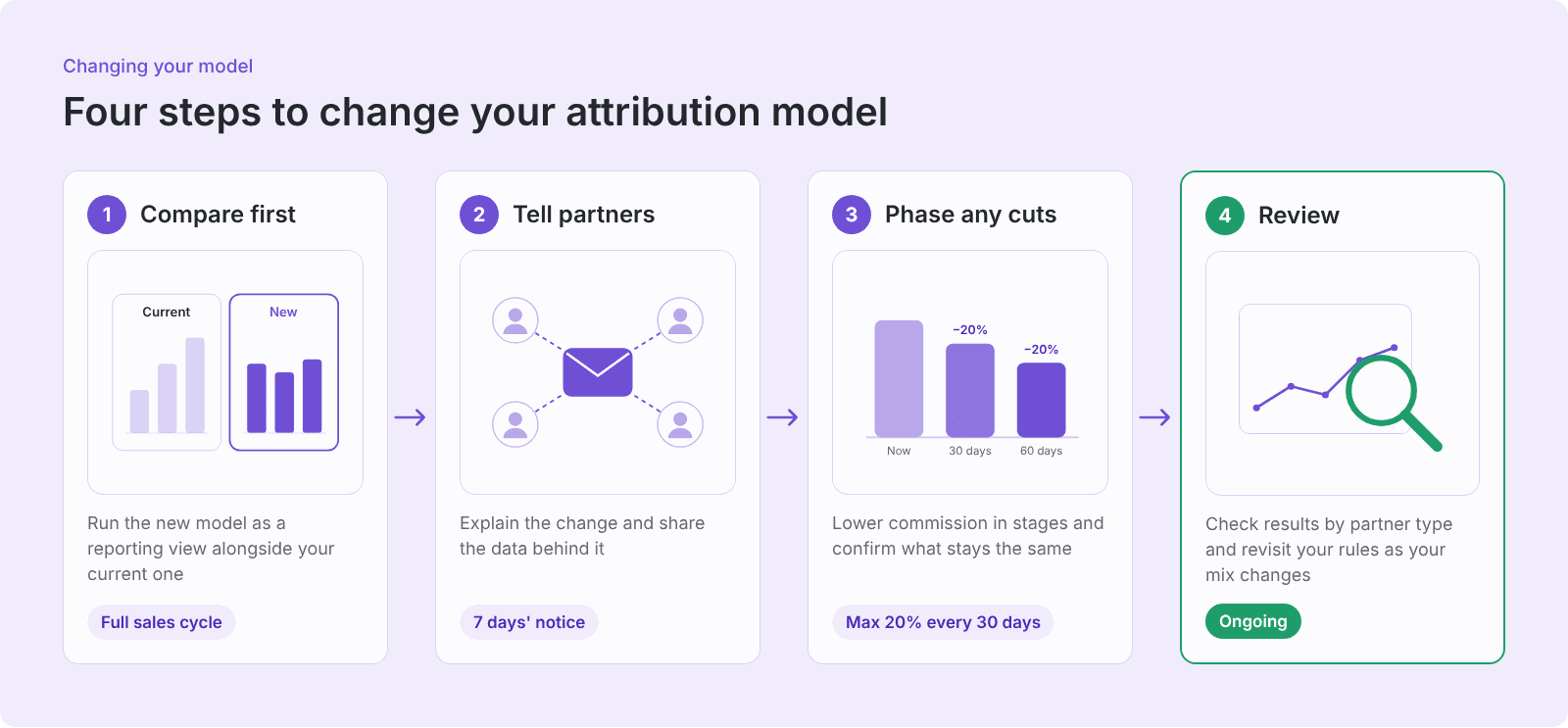
Changing your model changes what partners earn, so make the switch in stages.
- Compare first. Run the new model as a reporting view alongside your current one, long enough to cover your usual sales cycle. Check how each partner's earnings would move before you change any commission.
- Tell partners. Give at least 7 days' notice through the Communication Center when you update your programme terms. Explain why you're changing, and share the data behind it. Your updated terms show on your programme profile and in the Awin Advertiser Directory, so partners can check them at any time.
- Phase any commission cuts. Awin allows a reduction of no more than 20% at a time, once every 30 days. If you're on Advanced, you can trial a new rule with one publisher group through Attribution Manager before applying it across your programme. Let partners whose earnings stay the same know that too, such as cashback partners on last click sales.
- Review after the change. Check results by partner type, since some partners may promote you more and others less. Build a regular review into your affiliate management routine, and revisit your rules whenever your partner mix changes.
FAQs on affiliate attribution models
What is the most common affiliate attribution model?
Last click is the standard on Awin and a common default across affiliate programmes. It gives the full commission to the final affiliate click before purchase. On Awin, a cookie hierarchy also ranks click types, so a standard click outranks a soft click or an ad view.
What are the four types of attribution?
The four types usually named are first click, last click, linear and time decay. Some guides include position based or data driven attribution instead. In affiliate marketing, each one decides which partner earns commission when more than one partner was involved in the sale.
Do affiliates get paid for every click on their link?
No. Affiliates earn commission when a click leads to a sale that the programme's rules credit to them. If another partner's click wins under the model, or de-duplication credits another channel, that click earns nothing. Some brands add tenancy fees or Payment on Influence to reward partners outside the model.
What is the difference between MTA and MMM?
Multi touch attribution (MTA) credits individual touchpoints in each customer journey, using tracking data. Marketing mix modelling (MMM) uses aggregated spend and sales data to estimate how each channel contributes overall. MTA suits day to day partner decisions, and MMM suits budget planning across channels.
Why do GA4 and affiliate platforms report different sales?
Each tool uses its own model and tracking. GA4 defaults to data driven attribution across all channels, while affiliate platforms credit partners using programme rules and de-duplication. GA4 can also miss affiliate touchpoints, so the two sets of figures rarely match exactly.
Can any attribution model see every touchpoint?
Every model has blind spots. Customers switch devices, discover products through AI assistants and decline cookies, which leaves some touchpoints untracked. First party tracking through the Awin MasterTag, cross device tracking and reports such as Journey Path close part of that gap.
Ready to choose the right model for your programme?