Our Top Affiliate Marketing Predictions for 2026
Written by Richard Towey on 10 minute read
Industry experts from around the world lay out their biggest bets for affiliate marketing in 2026.

With the onset of AI and rapidly changing shopping behavior cranking up the appetite for guidance, the Awin-Win Podcast invited a host of experts to overview their biggest trends impacting the affiliate industry in 2026.
We’ve summarized the most globally applicable talking points below. If you want the full list, be sure to check in with the corresponding podcast episodes.
Key affiliate marketing trends in the UK and US
Panel:
- Kevin Edwards (Founder, Affiliate & Partner Marketing Association)
- Max Willens (Principal Analyst, eMarketer)
Key topics:
- Why influencer is set for another growth spurt
- Where AI will have the biggest impact on the affiliate industry
- Coupons: positive or negative?
Key affiliate marketing trends in Europe
Panel:
- Julian Weiß, Head of Affiliate Marketing, Xpose360
- Bill Fisher, Principal Analyst, eMarketer
- Kelli Parkja, Country Client Services Director, Awin
Key topics:
- The growing demand for trusted voices and the rise of micro creators
- Why affiliate spend is insulated from wider economic challenges
1. We’re calling it: this year will be a net positive
Why not start on an upbeat note? According to forecasts from eMarketer, affiliate marketing will drive $1 in every $7 in US eCommerce sales next year. That’s reason enough to be positive, according to Max Willens (Principal Analyst, eMarketer), who believes such a reading indicates a channel “trending in the right direction”.
That tallies with the view of Julian Weiß, Head of Affiliate Marketing at digital agency Xpose360, whose in-house research points to an increase in affiliate spend by 27% of German marketers, despite the shrinking of ad budgets.
With brand partnerships, influencers, and tech partners all giving advertisers a host of new options to launch on their programs, it’s refreshing to hear there should be funds to test them.
2. Challenges are on the horizon. But don’t expect firm answers and action.
If affiliate marketing was a playlist, it would be something along the lines of ‘good energy’ or ‘positive mix’. The bigger question is, how long does it last for?
Max has his doubts over whether the current glow will stretch much beyond 2026:
”Essentially, growth in the channel will outpace overall retail e-comm sales growth… But that high level of optimism is also mixed in with pretty intense anxiety about what's going to happen in the near term, right?”
Few will be surprised by the core challenges raised by our experts, which were:
- The reliability of affiliate tracking
- The influence of large language models (LLM) on shopping behavior
- Declining consumer confidence and ad budgets
You roll that up, and there are a whole host of questions in the near term. But from Kevin Edwards’ vantage point of budget priorities among his APMA members, the industry isn’t rushing into a response:
“ Recently, we ran a session with members and we asked for their challenges and opportunities … A lot of them are just continuing the same things. I don't think that's necessarily a bad thing because it shows continuity. Inevitably, AI comes through very, very strongly. I think that we're still in that very nascent phase of AI where people are just sort of struggling to grasp the concept.”
So there you have it. If you’re weighing up your own response to generational challenges like AI’s influence on the future of affiliate marketing, at least you’re not alone.
3. Convergence of affiliate and influencer will continue
Probing further on the topic of budget priorities, there was another popular talking point: influencer marketing.
Max rightly points out that major social platforms have been inconsistent in their support of creators wanting to generate revenue through affiliate links. TikTok has perhaps been the most aggressive, rolling out a suite of new functionality to incentivize creators to drive sales for sellers on TikTok Shop, rather than external sites.
Despite their attempts to steer creators away from external affiliate links, Max believes the platforms’ continued interest in “facilitating transactions in any way” is likely to benefit those tasking influencers with driving hard sales.
Julian also believes AI and its poor recommendations will inadvertently spur this trend forward, encouraging people to increasingly buy from people, not robots.
In 2025, the IAB’s Creator Economy survey found that three in every 10 US advertisers were working with creators via an affiliate network. Max expects that number to climb “significantly” in the new year.
4. Affiliate gains full-funnel plaudits
It’s no secret that affiliate partners can deliver real results both before and after the ‘last click’. Just ask the editorial sites raising awareness for brands like Lovehoney or the tech providers helping major telcos like EE reduce churn through partner-funded rewards.
Affiliate marketing has a lower, mid, and an upper funnel. And given the frequent stories of brands like Bärbel Drexel increasing their affiliate revenue after reducing their reliance on bottom-funnel tactics, Julian sees 2026 as the year that affiliate starts to showcase its wider value.
“My boldest prediction would be that at the end of the year, we change the image of affiliate marketing when it comes to decision makers and they see us as the strategic full-funnel channel that we are.”
5. Micro creators will lower the barrier to influencer entry
As you might have guessed, the experts were extensive in their commentary and interest in influencer marketing.
While the Cristiano Ronaldos of the world remain out of reach for the vast majority of brands, creators with smaller audiences but higher levels of engagement have opened the door to a new wave of investors.
One look at the typical pricing of Instagram influencers more or less summarizes the situation:
Nano influencers (1,000 - 10,000 followers): $10 - $100 per post
Micro influencers (10,000 - 100,000 followers): $100 - $500 per post
Mid-tier influencers (100,000 - 500,000 followers): $500 - $5,000 per post
Macro influencers (500,000 - 1 million followers): $5,000 - $10,000 per post
Mega influencers: (1 million+ followers): $10,000+ per post
While mega influencers might have the reach, they might also charge nearly 10,000% more than a nano creator per post.
Research from Magic Numbers also shows creators with fewer than 5,000 followers prove their worth with an 18:1 ROI, vastly outperforming the 5:1 managed by those with 160,000 followers or more.
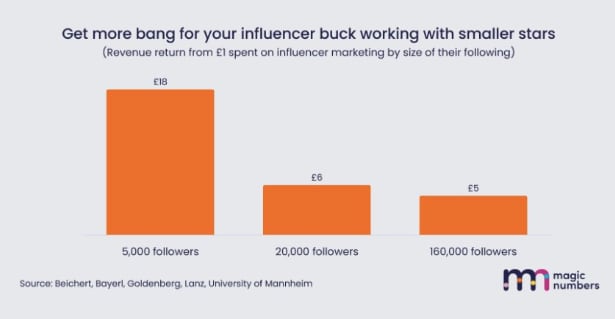
Our panel was optimistic about the potential for small-scale creators to level the influencer playing field in 2026.
|
“ This is the beauty of the creator and influencer economy, right? Smaller brands that don't have these massive ad budgets can reach a very engaged, very targeted audience by partnering with micro influencers… We absolutely see better engagement with micro influencers. You get the reach with the Mr. Beasts of this world… But they're going to cost a lot of money.” |
|
Bill Fisher, Principle Analyst, eMarketer |
6. Retail media will ride on the same recession coattail as affiliate
As history shows, challenging economic conditions can work in favor of affiliate marketing. Its paid-on-performance model becomes a haven for marketers looking to do more with less.
Bill believes the current cost pressures should impact other channels with a unique role in the customer journey, namely retail media.
“ When conditions get tough, a lot more spend gets drawn towards search closer to the consumer… What we've seen recently in the past couple of years is that retail media has had a huge boost in interest and in spending because that's as close to the consumer as you can get, and it's as close to the purchase intent that you can get as well. That's one area where we've seen a lot of growth recently.”
The good news is that affiliate has a stake in this area, too. Awin advertisers such as The AA and SimplyCook have been quick to position themselves at the checkouts of a host of well-known retailers, only paying for each customer they acquire.
If you’re interested in learning more about how this works on an affiliate program, either as an acquisition channel or a way of unlocking more revenue as a distributor of brand partner rewards, here’s a little more information.
7. China chalked down as top ‘market to watch’ in 2026
When discussing the markets tipped for growth in 2026, there was a robust case brought forward by Max for China.
While the market has been among the hardest hit by the US charging duties on imports valued at $800 or less, the immediate popularity of its direct-to-consumer brands in many foreign markets underlines the consumer appetite for low-cost products.
Max raises that Chinese advertisers have invested heavily in paid social to expand into new territories. He “absolutely” sees the same happening in affiliate, with advertisers partnering with publishers across the world to broaden their reach.
8. GEO to chip away at SEO
Encouraging the experts to give their boldest predictions for the year ahead brought things back to AI. In Bill’s case, there was another batch of bad news for one of the biggest traffic sources going:
“I do think Google is going to continue to invest in AI, so I think the role of SEO in the affiliate space will diminish. I can’t see a future where GEO [generative engine optimization] won’t become the center of the affiliate universe.”
Publishers have already been advised to future-proof their sites by considering and tracking contributions from alternative traffic sources. On Awin, that’s made easier through our integration with wecantrack, which crunches data from over 350 affiliate networks and marketing platforms to give publishers the insights to diversify their visitor acquisition.
Bill doesn’t predict the wholesale shift of traffic SEO to GEO in 2026, but the next year will only see things moving in one direction.
Want the full list of predictions and deeper analysis into each point? Check out the affiliate trend specials of Awin-Win Marketing Podcast for the UK and US, and Europe.